
Article | 12 minutes read
We published a ten-year forecast for Alberta’s online gambling market on July 9, four days before the market it modeled opened. A week after launch, there is something to check it against.
Alberta’s regulated iGaming market opened at midnight on July 13, ending the Play Alberta monopoly of the Alberta Gaming, Liquor and Cannabis Commission (AGLC). What followed was a rolling, week-long launch.
Sites went live in batches, suppliers certified content one at a time, and the market’s true shape only became visible after seven days. We built a proprietary model of this market before anyone knew what launch day would look like. Checking it now means comparing it against a week’s worth of evidence.
| July 13, midnight | 22 operator sites go live |
| July 13, midnight | 50 brands registered with AGLC |
| July 13 | IGT PlayDigital live, 130+ titles |
| July 13 | Everi casino titles live |
| July 13 | Pragmatic Play slots and live casino certified |
| Launch week | Altenar confirms entry |
| July 20 | Greentube (NOVOMATIC) content live |
Alberta’s framework runs on the same dual-track structure Ontario uses. AGLC regulates and issues registrations under the iGaming Alberta Act (Bill 48, passed May 2025), while the Alberta iGaming Corporation (AiGC) conducts and manages the commercial market. Operators pay a one-time application fee of C$50,000 and an annual registration fee of C$150,000 per brand.
From gross gaming revenue, 2% funds First Nations initiatives and 1% funds social-responsibility programs; of what remains, the government takes 20%, and operators keep 80%. Day-one brands included FanDuel, DraftKings, BetMGM, bet365, BetRivers, theScore Bet, and Caesars among the 22 live sites.
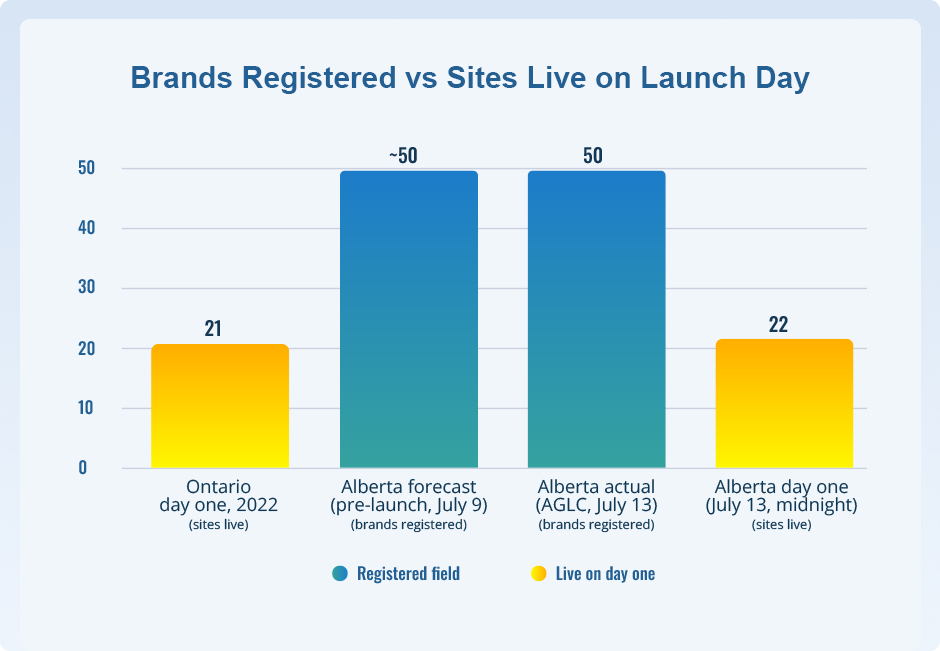
Our pre-launch Alberta market research called a day-one field triple the size of Ontario’s: roughly 46 operators and about 50 brands/sites registered. Ontario had approximately 13 operators and 21 sites when that market opened in April 2022.
On registration, that call held up well. The AGLC gaming registrants list confirmed 50 registered brands by launch. That count matched our brand estimate almost exactly. Much of the launch coverage used “operators” and “brands” interchangeably, where our model kept the two separate.
On live operators, the picture is different. Twenty-two sites were taking bets at midnight on July 13. Measured against Ontario’s own day-one live count of 21 sites, that is close to parity. The registered field’s size had implied a far bigger leap. The gap is not really a forecasting miss; it is a definitional one.
Our research measured the registered field, triple Ontario’s, against Ontario’s day-one live count. It did not measure that field against what would actually be live on Alberta’s own day one. Alberta, like Ontario before it, is rolling operators onto the market over the course of weeks; they did not all go live at once.
Two outside revenue figures are circulating for Alberta’s market, and they measure different things. Minister of Service Alberta and Red Tape Reduction Dale Nally has projected C$76 million in first-year iGaming revenue for the province, a government estimate.
Separately, forecaster H2 Gambling Capital projects C$1.7 billion in total onshore-regulated gross gaming revenue for the province’s second fiscal year. Our own reconciliation places that figure at or above our model’s bull case for that period. It sits well beyond our base case.
Operator counts make headlines, but depth of content is what lets the next 28 registered brands differentiate once they launch. Ontario showed how much of that work happens after launch. Its market grew from 21 day-one sites to 45 operators and 76 gaming websites by the end of its first year, according to iGaming Ontario’s market report. Alberta’s week one gave an early look at that pipeline before most of the registered field had even gone live.
Greentube, NOVOMATIC’s digital gaming division, completed its AGLC registration ahead of launch. It went live in Alberta on July 20, a full week after the market opened. Alberta is only the second Canadian province with a regulated private iGaming market. Greentube has now gone live in both, offering titles like Piggy Prizes: Wand of Riches 2 and Rumble Riches Haulin’ Gold, alongside the established Starlight Jackpots Captain’s Catch.
The same week brought more supplier-side arrivals. IGT PlayDigital launched more than 130 games into the Alberta market alongside Everi titles. Both were live from day one.
Pragmatic Play also certified its slots and live-casino portfolio for launch day. Altenar confirmed its Alberta entry in the same window. Those are just some of the suppliers that went live or confirmed entry across the week, most of them on day one, and Greentube a week later.
That spread, more than the operator count, is the signal worth tracking as the remaining registered brands come online. With 58 critical gaming systems providers and 14 platform providers currently registered with AGLC, operators have plenty of scope to differentiate their sites from the competition.
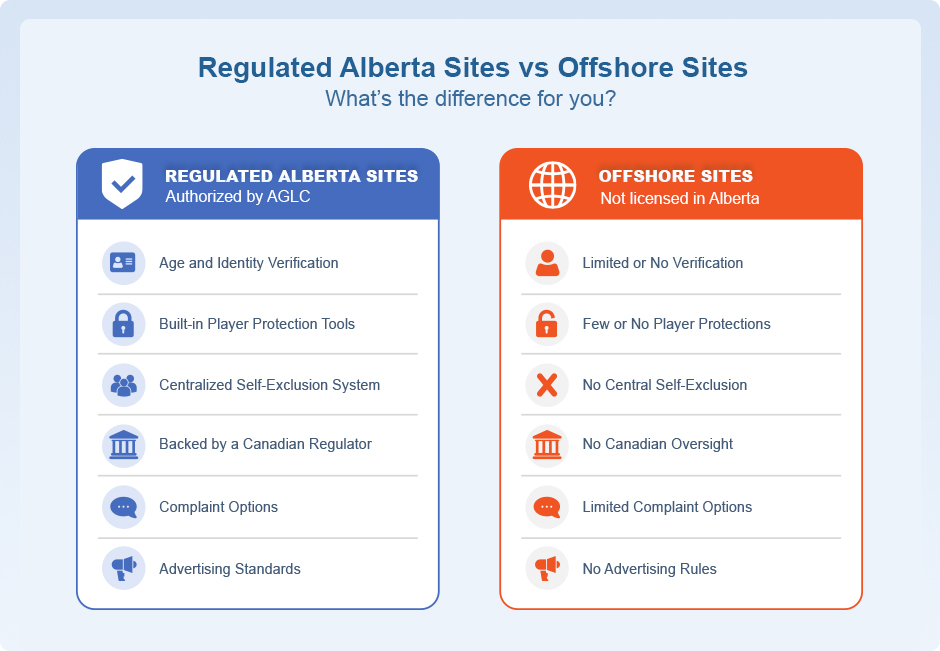
Before launch, an estimated 70% of Albertans’ online gambling activity ran through unregulated, offshore sites, according to the Government of Alberta. Those sites could operate with limited or no player protection measures in place. That share is the reason the province built a regulated market at all. It is also the most direct way to explain what changed on July 13 for anyone who was already playing.
Our behind-the-scenes report from SBC Canada highlighted Alberta’s business-first approach to launching its regulated iGaming market. Minister Nally emphasized the province is investing heavily in harm mitigation to keep its online gambling industry safe.
On a regulated Alberta site, age and identity are verified before a player can deposit. Players must prove they are 18 or older. Deposit and time limits are built into the account rather than offered as optional extras.
Self-exclusion runs through a single, centralized system that covers every registered operator: sign up once, and it applies everywhere. The AGLC’s Self-Exclusion Program is a tool Alberta built in from day one, whereas Ontario’s own version arrived later.
A player also gains the backing of a Canadian regulator for each site. AGLC handles registration, standards, and compliance; AiGC manages the commercial agreements that let an operator go live in the first place. If an operator does not resolve a dispute satisfactorily, players can register their complaint with AGLC. These safeguards do not exist at offshore sites.
Advertising is also bound by AGLC standards. These rules keep marketing away from minors and at-risk players, something offshore operators are not required to follow.
Checking whether a site is licensed is simple. AiGC provides a full list of registered iGaming sites that are currently live in the province. A brand not on that list is not authorized to operate in Alberta, regardless of how familiar the name may look.
If you or someone you know is struggling with gambling, every AGLC-registered site is required to offer self-exclusion. Alberta Health Services also runs a 24/7 Addiction Helpline at 1-866-332-2322.
Twenty-eight registered brands have not yet gone live. Based on Ontario’s rollout and Alberta’s first week, expect more of the same: launches will keep coming in stages, with no second big-bang day. Each new brand should deepen the supplier and content picture. The headline operator count will move far less.
Three things are worth watching past week one. Will advertising standards hold up once dozens more brands are marketing simultaneously? Will enforcement have real power against operators still taking Alberta players without registration? That is something Nally’s own language left little room to misread.
And what about channelization, the share of Alberta’s online play that moves onto regulated sites? How it is measured and reported once real data replaces pre-launch estimates is still an open question. Our reading of the Netherlands’ own channelization data suggests it will not settle quickly or cleanly once it starts.
We will revisit this model against the first AGLC or AiGC data release, as we said we would before launch. Until then, the week-one scorecard reads: registration matched our call almost exactly, and going live took longer than the field size implied. The real test, whether Alberta channelizes offshore players the way Ontario eventually did, is still ahead of the data, not behind it.