Article | 2 minutes read

The 18th birthday is the end of the gambling journey, not the start of it. By the time many Dutch teenagers pass their first age check, they have been gambling for years.
Underage gambling means taking part in games of chance for money below the legal minimum age. In the Netherlands, as in most of Europe, that age is 18 for every gambling product.
The scale is documented. In a Dutch vocational-school sample of 29,724 students, 28% of minors aged 15 to 17 said they had gambled in the past 12 months.
Among those minors who gamble, 51% took part in at least one high-risk product: casino games, sports betting, or slot machines. On a shortened Problem Gambling Severity Index (PGSI), 4.5% already report some degree of gambling harm.
Those figures come from one of three studies the Netherlands Gambling Authority (Kansspelautoriteit, or KSA) published on August 20, 2026. Read together, they trace the full path: where the habit forms, how minors get around age verification, and what happens on the first legal account.
Each study answers a different question, and each has limits its authors state plainly. Here is what each one can and cannot tell you.
| Study | Design | Sample | What it can show | What it cannot |
|---|---|---|---|---|
| Kansspelreis onder 18 jaar in beeld (Youngworks, July 2026) | Qualitative: smartphone app tasks plus in-depth interviews | 50 young people aged 16 to 21 did app tasks; 24 were interviewed (22 young men, 2 young women) | Mechanism and motivation: how the habit forms, in participants’ own words | Prevalence: findings are indicative, not generalizable |
| Onderzoek naar het gokgedrag van jongvolwassenen (KSA, 2026) | Account-level analysis from the regulator’s control database | 15,761 accounts that staked in May, of 16,266 opened May 1 to 7, 2025; tracked for three months | Real behavior with no self-report bias | Anything before the first legal account: the database starts counting at 18 |
| Gokgedrag en gokschade bij mbo-studenten (KSA, 2026) | Secondary analysis of the TestJeLeefstijl school lifestyle survey | 29,724 vocational students, 2024-25 and 2025-26 school years | Scale within one large student population | Representativeness: not a sample of all minors, nor of all vocational students |
We read all three reports in their Dutch original copy. Every figure in this article comes directly from the full reports, not from the regulator’s press summary.
Each stage of the journey now has ages attached, thanks to the Youngworks interviews.
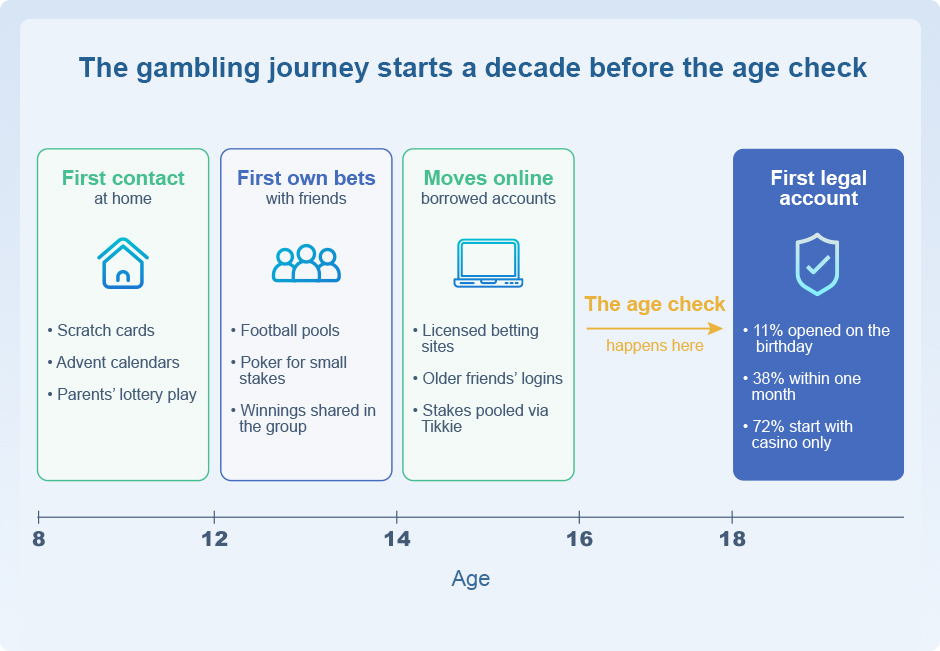
First contact comes between roughly eight and 12, mainly at home. A scratch card under the Christmas tree, an advent calendar of scratch tickets, a family poker night, parents playing the lottery. Children do not read any of it as gambling. That framing arrives only years later, in hindsight.
“I think the first scratch card was under the Christmas tree when I was about twelve,” one 16-year-old participant said (quotes translated from Dutch). “It has been there every year since. I still get one.”
Independent gambling starts between 12 and 14, and it is social from the first bet. Friend groups organize football pools, debate results, and stake together. Poker rounds at someone’s house run for hours on small stakes, with winnings often spent on snacks for the group.
Between 14 and 16 the activity moves online, onto licensed Dutch brands. TOTO, bet365, BetCity, and Unibet were the names participants mentioned most. The channel changes but the group does not. Stakes are still discussed in the chat, and wins are still shared.
Online age verification in the Netherlands works at account level. The law requires licensees to check identity and age but leaves them the method, and most use iDIN, the banks’ identity service that also ties into the Cruks register. Either way, the account holder really is 18. The person playing often is not.
Borrowed accounts are the standard route. An older brother or an 18-year-old friend hands over login details, usually with no warning attached about risk. Less commonly, a parent opens the door. Fathers in particular sometimes open one on their own initiative, treating it as a safer way to gamble together.
Study participant, boy, 16 Youngworks in-depth interviews (translated from Dutch)
Money moves through Tikkie, the Dutch peer-to-peer payment app. Group members send their stakes to the account holder, who deposits the total. Winnings come back out the same way, split between friends.
Study participant, boy, 17 Youngworks in-depth interviews (translated from Dutch)
Group play on one login completes the picture. The group picks the games and sets the stakes together, then splits whatever comes back. One age check covers an entire friend group.
Among minors in the vocational-student survey who gamble, the leading products are scratch cards (46%), bingo (34%), and slot machines (28%).
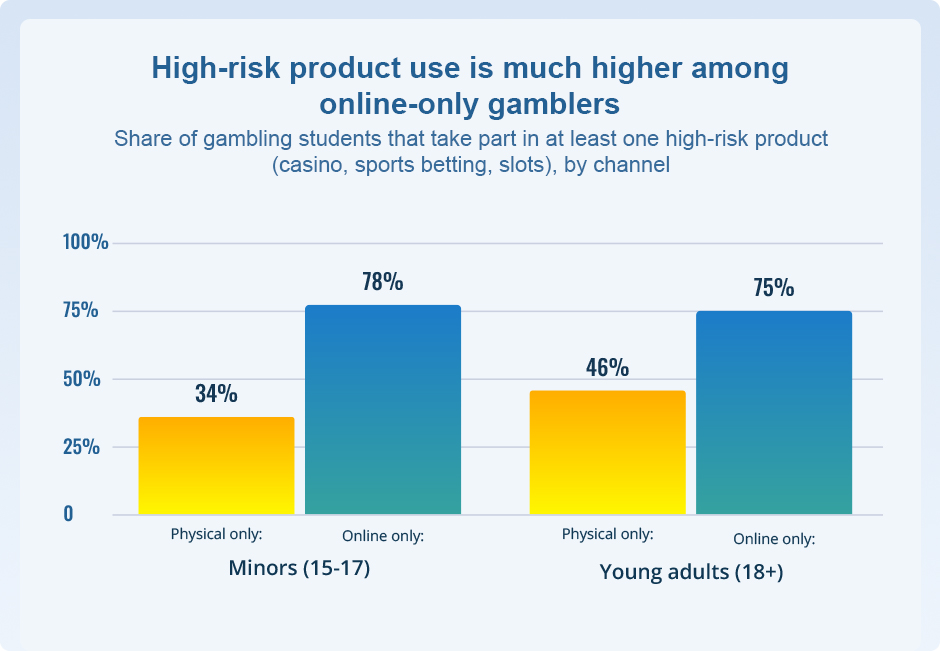
Channel matters more than the product list. Of minors who gamble only online, around 78% take part in at least one high-risk product, against 34% of those who gamble only at physical venues. Among young adults the same gap is much narrower, at 75% against 46%.
Roughly one in five online student gamblers also plays something outside the survey’s product list. The report’s authors suggest loot boxes and skin betting as possible explanations.
Youngworks had participants log every gambling encounter for 24 hours. Brand choice ran on visibility and familiarity rather than product features: advertising on TikTok, brand recognition from international sports broadcasts, names their friends already used. The young people found the volume strange themselves.
“On TikTok I get quite a lot of those ads from the Staatsloterij,” a 16-year-old said. “I find it strange that a gambling organization run by the government advertises on a platform like that, and tries to get us gambling. In my opinion, that is not right.”
In June 2026 the Dutch government announced a near-total ban on gambling advertising. The exposure logs read as an evidence base for that decision. The ads these minors saw were overwhelmingly for legal brands, and brand familiarity is exactly what steered their choice of operator at 18.
Account data shows what the end of the journey looks like. Of all online accounts opened with Dutch licensees in the sample week of May 1 to 7, 2025, 14% belonged to an 18-year-old; within the 18-to-24 group, 41% did. 11% of 18-year-olds’ accounts are opened on the birthday itself and 38% within a month of it.
Casino is the first product. Across the whole 18-to-24 group, 72% of accounts began with casino games only. Across all age groups the choice sticks. 97% of casino-only accounts stayed with casino the following month.
That finding led the KSA to drop its own working theory that young adults enter through sports betting and move to casino. The correction matters, but it can be overread.
A database that starts counting at the first self-owned account is blind to everything before it. Youngworks shows the social entry point is football betting at 12 to 14, played on borrowed accounts. The gateway is real. It simply runs its course before the data begins. By the time young adults open an account of their own, casino is where they land.
The cohort data also separates 18-year-olds from the rest of the young-adult group. On accounts active in all three months, 18-year-olds gambled a median of 12 days per month, against 8 for 19-to-24-year-olds. Their median stake per gambling day in the first month was 88 euros, against 193 euros for the older group.
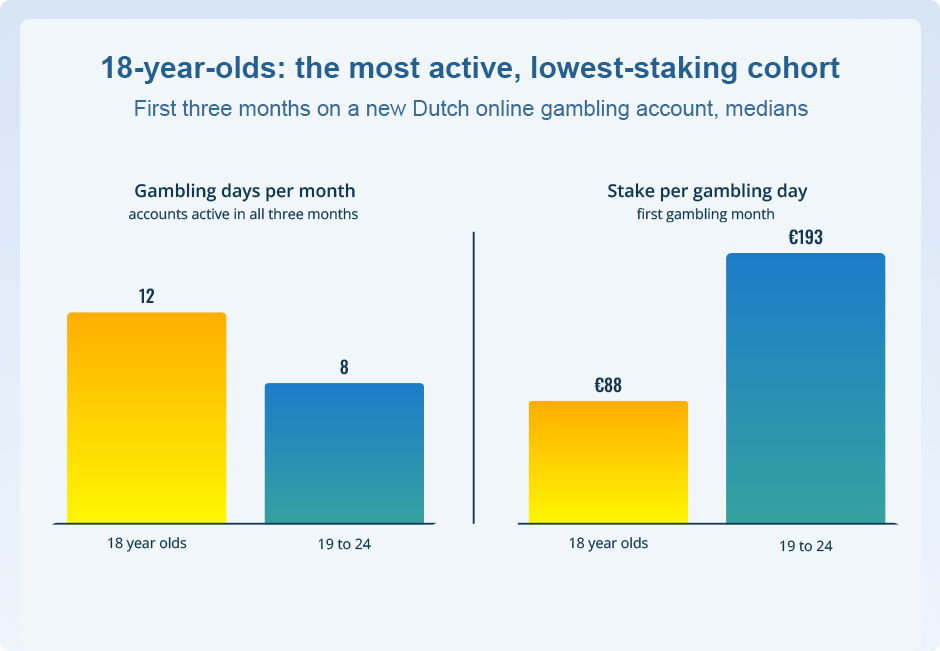
Risk models weighted toward how much a player stakes will tend to miss the pattern of more days at lower stakes. On a spend metric, an 18-year-old logging 12 low-stake days on an account active in all three months looks safer than an older player staking twice as much across eight.
Hardly. Spain’s consumer affairs ministry has reported an average age of just 13.9 for a young person’s first gambling experience. That sits squarely inside the 12-to-14 window Youngworks identified, and it echoes the warnings already documented around teenage gambling risks in Spain.
Across Europe, the ESPAD 2024 school survey found 23% of 15-to-16-year-olds in 37 countries had gambled for money in the past year. Italy leads that table at 45%, with Iceland (41%) and Greece (36%) behind it, putting two of the three markets at the center of the rising risk of teenage gambling in Italy and Greece.
The Netherlands adds the mechanism, documented end to end, including the borrowed account, the Tikkie transfer, and the birthday registration.
On June 12, 2026, State Secretary for Legal Protection Claudia van Bruggen sent parliament a progress letter on gambling policy. It announced an advertising ban, a bonus ban, and a central cross-operator deposit-limit register.
Set aside, though, was the previously announced increase in the minimum age for high-risk gambling to 21. Her stated reason was that young adults shut out of the legal market could move to illegal sites, where no protection exists at all.
Just over two months later, the three studies arrived, and they cut both ways.
At the problem end, the fear is real. The small group of participants who used illegal sites were largely those who recognized a gambling problem in themselves, including young people locked out by the Cruks self-exclusion register.
Study participant, 19, registered with Cruks voluntarily Youngworks in-depth interviews (translated from Dutch)
For everyone else, the evidence points the other way. Most participants knew illegal sites existed and rejected them, treating a missing ID check as the warning sign. Their disapproval of illegal operators even helped them justify their own play.
Borrowing a legal account is easy. That suggests the likelier substitute under a 21+ rule would be a lateral move onto someone else’s legal account rather than a slide into the black market that keeps pulling European players offshore.
None of this closes the question, because the Dutch legal market is fragile. Licensed online gambling has stagnated while the black market expands. Van Bruggen’s letter left the 21+ option open once enforcement against illegal supply improves, and these three studies are the evidence base that debate will use.
Five operational lessons follow from the cohort data.
Warning signs surface in the young people’s own words. Gambling alone rather than with the group, borrowing money to stake, and betting to win losses back.
Youngworks found three broad parental responses. Strict prohibition ended the conversation, as young people kept gambling and stopped talking about it. Open dialogue that named the risks kept the channel open, while active normalization, lending an account in the name of safety, removed the last barrier.
Participants themselves said they valued the open conversation, a finding consistent with what works in youth gambling awareness programs. For the practical side, device and account-level restrictions are covered in our guide to parental controls to prevent underage gambling.
Youngworks is qualitative: 24 interviews, 22 of them with young men, drawn from a self-selected group of frequent gamblers. It explains mechanisms but cannot measure prevalence.
Nor can the account study see who actually plays on an account, only who registered it, a real constraint given how often accounts are shared. And the vocational-student survey is not representative of all Dutch minors. It merges two school years and uses three of the nine PGSI items rather than the full screen.
For reference and further reading, here are links to the studies. All three were published by the KSA on August 20, 2026.
Cruks, the Dutch national self-exclusion register, blocks access to licensed online operators and land-based casinos, but it can only be used from age 18. The years in which the habit actually forms sit outside its reach.
Loket Kansspel, the national gambling helpline, is free and anonymous, and takes calls from players, parents and anyone worried about someone else. The national information and support site, Open over gokken, offers guidance for young people and parents. Support for parents and under-18s is also available through your GP and local youth services. The iGamingCare hub provides a professional help database and other useful support guides.