Ireland’s Self-Exclusion Register Is Still on Paper: Belgium Shows Which Boundaries to Test First

A self-exclusion register is a set of boundary decisions. Ireland has written some of them into law and left others open, and evidence from Belgium and Australia shows which ones are worth testing first.
Ireland has already made several of those decisions. Its National Gambling Exclusion Register is written into the Gambling Regulation Act 2024, but it is not yet in force and has no go-live date.
Four questions remain worth testing: the National Lottery line, the retail line, the length and exit rules, and the way the leak is measured.
Belgium supplies evidence on most of them. Its regulator asked self-excluded players where they still gambled, and its Constitutional Court has since redrawn part of the register’s scope.
Australia’s enforcement cases, the latest a penalty of AUD 1,069,200 announced in September 2026, show the leak from the operator side.
What Ireland Has Already Decided, and What It Has Left Open
The Gambling Regulation Act 2024 was enacted on October 23, 2024. Sections 44 to 49 create the National Gambling Exclusion Register, to be run by the Gambling Regulatory Authority of Ireland (GRAI).
None of those sections has started. The Irish Statute Book, updated to September 17, 2026, lists them as “Not yet commenced.” GRAI’s compliance FAQ says no date has been set for the register to go live.
Licensing has moved ahead without it. Remote betting licenses took effect on July 1, 2026, and in-person betting licenses follow from December 1, 2026. Neither date switches on the register.
Even so, the statute already settles who can sign up. Only the person concerned can apply, and the exclusion runs for an indefinite period. After six months, a registrant can ask GRAI in writing to remove the entry.
It also settles how the block binds. Operators must be able to view the register in real time. Once a name is on it, a remote operator may not offer that person gambling, take their payment or send messages inviting them to play.
Once the sections commence, a breach will be a criminal offense, punishable on indictment by up to five years in prison.
What the block covers is settled too. The register reaches gambling “by remote means” only: any means other than in person, including online, by phone or on television. The Act’s definition of “lottery” excludes “a lottery operated by an operator of the National Lottery.”
Asked in a written parliamentary question in January 2026 whether the register would apply equally to in-person gambling, the Minister for Justice replied:
Jim O’Callaghan TD, Minister for Justice, Home Affairs and Migration, Dáil written answer, January 13, 2026
Other decisions remain open. The Minister decides when the sections commence. GRAI still has to publish technical specifications for operators, and it decides how identity is checked at sign-up and what extra data the register holds.
Measurement is set only in outline: a review every three years that includes the number of people registered.
Belgium’s Survey: Measuring Where Excluded Players Go
Belgium has run EPIS, its Excluded Persons Information System, since 2004. Between March and June 2022, its Gaming Commission surveyed people who had excluded themselves through it.
The Commission invited 2,339 people who had signed up between January 2020 and April 2022. Of those, 275 replied, a response rate of 11.8%.
Researchers Xavier Noël of the Université Libre de Bruxelles and Gaëtan Devos of the Université Catholique de Louvain analyzed the answers. Their report was published in December 2022.
Respondents rated the scheme well, with 90.2% calling the exclusion procedure useful. Yet 74 of the 275 (26.9%) said they had played since excluding, on average about eight weeks afterward.
Those numbers deserve care. The survey is the regulator’s own, the answers are self-reported, and only people who chose to reply are counted. Every finding about where players went rests on 74 people.
A count of registrations could not have shown that leak, so the survey bears first on Ireland’s measurement question.
The survey is not new, and Belgium has moved since. On April 16, 2026, its Constitutional Court ruled on where EPIS checks must apply. The Commission’s 2025 annual report, published on September 16, 2026, counted 66,998 people excluded at their own request.
The Leak Map: Evidence for the Lottery and Retail Lines
Respondents who had kept playing were asked where. They could name more than one place. The shares therefore add up to more than 100% and are not slices of one whole.
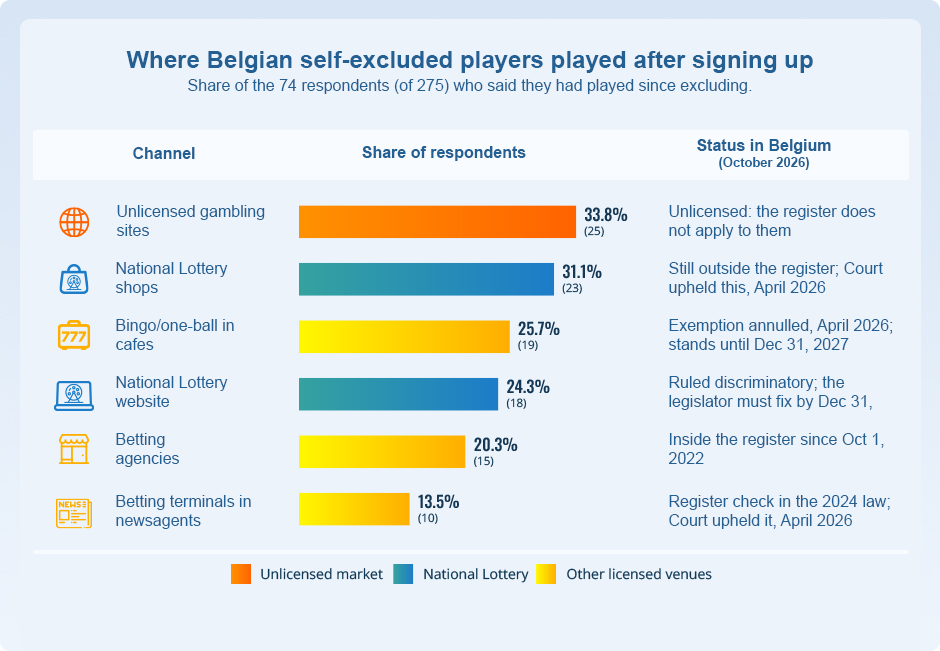
Unlicensed sites were the single largest answer, named by 33.8% (25 people). The National Lottery came next: 31.1% (23 people) bought its products in shops and other outlets, and 24.3% (18) used its website.
Bingo and one-ball machines in cafes drew 25.7% (19). Betting agencies drew 20.3% (15), and betting terminals in newsagents 13.5% (10).
Apart from unlicensed sites, every answer names a channel that EPIS did not cover when the survey ran. Betting agencies joined EPIS on October 1, 2022, after the fieldwork ended.
Why focus on the lottery? Unlicensed sites sit beyond any register’s reach, because only licensed operators are bound to check it.
Of the five other answers, two are National Lottery channels, and a state lottery is a legal product whose place inside or outside a register is set by statute.
One limit applies throughout. The survey records where people played, not how much harm each channel caused.
Belgium’s Constitutional Court has since redrawn part of that line. In judgment 45/2026 of April 16, 2026, it upheld the EPIS check regime but found two exemptions discriminatory.
The first concerns online National Lottery games, which escape both the prior EPIS check and the minimum age of 21.
Constitutional Court of Belgium, judgment 45/2026 of April 16, 2026, reproducing its judgment 165/2025 of December 11, 2025 (translated from Dutch)
The Court gave the legislator until December 31, 2026, to end that discrimination. Physical lottery sales were treated differently. The Court accepted that exemption, because lottery games played in the real world carry, in principle, a lower risk of addiction.
The second exemption covered cafes. They lost it, although the Court kept it in effect until December 31, 2027, at the latest.
The Court also upheld the EPIS check at betting shops, racetracks and newsagents. Belgium’s 2024 law newly applies it to newsagents.
So lottery products bought in shops, the second-largest answer, stay outside EPIS. Belgium is not alone in carving out a state lottery. Spain’s planned AI harm-detection system is set to exclude state-run lotteries.
Sweden’s regulator, Spelinspektionen, saw the same pattern in a 2023 survey of 607 self-selected respondents. Of the 41% who had gambled while excluded, 19% of them had bought lottery tickets in a shop, a channel Spelpaus, Sweden’s national register, does not cover.
None of it shows that Ireland will leak the same way. It does show where a first survey of Irish registrants would be worth looking.
The Operator-Side Leak: What Australia’s Cases Show About Measurement
Belgium’s map captures players finding gaps around a register. Australia’s cases show the other leak: licensed operators keeping registered people’s accounts and marketing alive. In August and September 2026, Sweden and the Netherlands showed two other ways a self-exclusion register can break: in the code that queries it and at the venue door.
On September 16, 2026, the Australian Communications and Media Authority (ACMA) announced that Dabble Sports had paid AUD 1,069,200 in penalties over BetStop, the national register.
Dabble had failed to close 157 wagering accounts after their holders registered, and had sent 165 registered people 839 marketing messages.
The investigation began on July 2, 2025, with two marketing complaints. ACMA then sampled 100 of Dabble’s registered customers, and Dabble self-reported a “birthday campaign” to 151 more. The register had flagged all 151, but “a staff error in configuring the birthday message template” put them back on the send list.
The cause lay in how Dabble’s system was built. It queried the register when customers logged in, bet or were about to be marketed to, but never for inactive accounts.
ACMA’s report says Dabble’s system “had the capacity to check the register for inactive accounts but it chose not to implement this function.”
Accounts were closed between 8 days and more than 18 months after registration. ACMA set the practicable standard at a check of inactive customers at least every seven days, and counted 19,750 daily contraventions across all 157 accounts.
Dabble follows six ACMA findings published on January 29, 2026, which also began with consumer complaints.
For Ireland, the lesson sits in the measurement question. Complaints found two people; the investigation that followed, with its sample and Dabble’s own self-report, found 157 accounts.
Ireland’s Act requires operators to be able to view the register in real time, and to refund a registered person’s balance within seven days of the date set in GRAI’s notice.
It does not say how often a dormant account must be checked, or that it must be closed; those are matters for the technical specifications GRAI has yet to publish.
Scope, Scale and Enforcement: Five Registers, Five Sets of Boundaries
Size shows how many people a register reaches, not how much leaks around it. Each regulator also counts something different, on a different date.
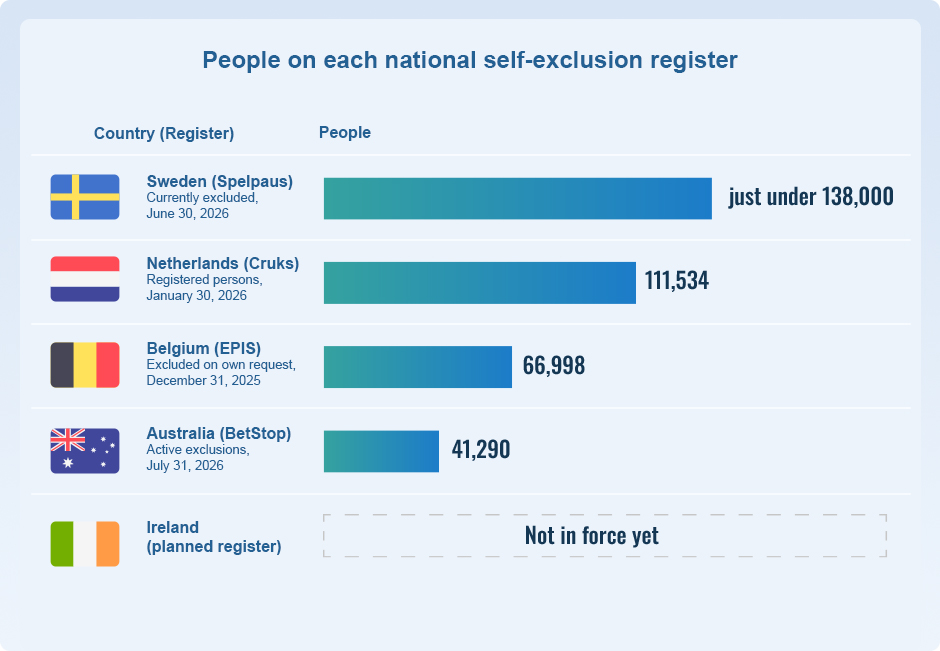
The chart above sets Spelpaus, Cruks, EPIS and BetStop side by side, with Ireland’s register shown as not yet in force. Denmark’s register, ROFUS, which passed 60,000 registrations by May 1, 2025, counted 73,550 through July 2026.
BetStop’s figures show why a count needs a definition. At its third anniversary, ACMA reported that 67,480 people had registered by July 31, 2026, but only 41,290 exclusions were still active.
| Register | Online gambling | Online state lottery | Venues and retail |
|---|---|---|---|
| Belgium (EPIS) | Yes | No; court deadline end-2026 | Most; cafes exempt to end-2027 |
| Australia (BetStop) | Wagering only | No | No |
| Sweden (Spelpaus) | Yes | Yes | Some; VLTs, registered play |
| Netherlands (Cruks) | Yes | No | Casinos and arcades only |
| Ireland (planned) | Yes, once live | No | No; “no plans” |
Table note: scope as stated by the Belgian Gaming Commission and Constitutional Court judgment 45/2026; ACMA and the December 2025 BetStop statutory review; Spelinspektionen; the Dutch Gambling Act (Wet op de kansspelen) and the KSA; Ireland’s Gambling Regulation Act 2024 and Dáil written answers.
On the table, Ireland’s remote-only design sits closest to Australia’s. Every register shown leaves offline lottery tickets and scratch cards outside; they differ on online lottery games and on venues.
Enforcement levers differ as much as scope:
- Belgium: operators must identify every person and check EPIS, and admitting an excluded person carries criminal sanctions.
- Australia: civil penalties of up to 750 penalty units for each day a registered person is served and 180 for each day an account stays open. Dabble’s AUD 1,069,200 priced 54 account-days at AUD 19,800 each, out of 19,750 counted; five of the six January 2026 cases ended with one penalty payment, three audits and a warning.
- Sweden: sanction fees from SEK 5,000 up to 10% of the previous year’s turnover and, for serious breaches, license revocation or a warning.
- Netherlands: fines up to the sixth penal category or 10% of turnover, whichever is higher.
- Ireland: a section 46 offense carrying up to five years on indictment, once commenced. Separate administrative penalties are capped at EUR 20 million or 10% of turnover, whichever is greater.
Each of these penalties depends on someone finding the breach first, which brings the comparison back to measurement, the question Ireland’s Act says least about.
Four Design Questions Ireland Can Still Test
- The National Lottery line: The Act leaves the National Lottery out, so the register cannot reach its online games. In Belgium, 24.3% of those who kept playing used the lottery’s website.
- The retail line: Under the Act as written, the register covers remote gambling only. The Government has said it has no plans to extend it, and in-person betting licenses start on December 1, 2026.
- How long, and how to leave: Ireland offers one term: indefinite, with a removal request possible after six months. The Act sets no further waiting period after a removal request, and says nothing about the account once the entry is removed.
- How the leak will be measured: Section 49 requires a review every three years that includes the number of people registered. That count measures uptake.
On the lottery line, Ireland’s lottery already runs its own lock-out. The Regulator of the National Lottery requires one for online instant-win games, for a minimum of two days.
In 2023 that regulator withheld EUR 150,000 from the operator after a 2022 breach finding on the deletion of permanently self-excluded accounts. Nothing in the 2024 Act links that lock-out to the national register.
Finland, building its own planned national self-exclusion register while Veikkaus keeps exclusive rights to lotteries, faces a version of the same question.
On retail, Belgium brought betting agencies into EPIS on October 1, 2022, and one in five Belgian respondents who kept playing had used one. In Ireland, operators’ own exclusion schemes stay in place under section 48.
The exit may deserve as much design as the entry. In Belgium’s survey, 42.5% of respondents were considering asking soon for their exclusion to be lifted. A lifting there takes effect only after three months.
BetStop runs from three months to a lifetime. The period cannot be reduced, but after the first three months a registrant can apply for removal with a statutory declaration of counseling or advice.
The exit also needs an account rule. ACMA’s Dabble report calls it a key principle that a person who comes off the register must “actively re-apply to open a new wagering account.”
Dabble had served one customer again from an account left open through a three-month exclusion. Ireland’s section 47 removes the entry and notifies the person, and stops there.
Registration totals are the familiar metric, as when Portugal’s regulator reported 326,400 self-exclusion registrations in Q2 2025. A first Irish review could test both sides of the leak instead. That would mean a survey of registrants, as Belgium ran, and checks on operators’ systems, as ACMA has now required in several of its cases.
Belgium’s map exists because its regulator asked excluded players where they still gambled. Ireland’s register will open with its boundaries already drawn. Whether they sit in the right place is something only its registrants can tell, and only if someone asks them.
For anyone weighing whether to sign up, our guide to how self-exclusion works for players covers the steps and the limits.
If gambling is causing problems for you or someone you know, help is available. In Ireland, the Gambling Awareness Trust’s national helpline is 1800 936 725, 24 hours a day. In Belgium, SOS Gokken is on 0800 35 777. In Australia, the national gambling helpline is 1800 858 858.
Related Articles