Article | 12 minutes read
The players Spain’s deposit cap binds hardest sit in the spend band most likely to gamble outside it. That is the picture in H2 Gambling Capital’s data, presented at the Gaming in Spain Conference in Madrid on October 15, 2026. H2 expects €300m less licensed spend, with €80m moving offshore.
From March 25, 2027, every licensed operator in Spain will count a player’s deposits against one shared set of default ceilings: €700 a day, €1,750 a week and €3,300 over four weeks.
The regulator, the Directorate General for the Regulation of Gambling (DGOJ), runs the central system. The detail of how Spain’s joint deposit caps work is in our July analysis.
Prof. Dr. Andreas Ditsche, CEO of iGaming.com, was in the room in Madrid when H2’s COO, Josh Hodgson, presented the figures.
H2 measured the change against the forecast it made before Royal Decree 520/2026. Against that path, it now expects licensed online gross gaming revenue (GGR, the amount players lose) to come in €300m lower. Of that, €80m moves to offshore operators and €220m stops being gambled at all.
H2 puts the hit at about 7% in each of 2027 and 2028, leaving licensed revenue around 14% below its earlier path.
Growth stalls but does not reverse. The licensed market still reaches €2.15bn in 2028, up from €2.0bn in 2026. The offshore market gains about 6% in each year on top of its existing growth, from €590m to €830m.
Read as a protection measure, most of that is good news. Almost three-quarters of the lost spend, €220m of the €300m, is money that is no longer gambled, which is what a deposit cap is for. The remaining quarter is the problem.
| H2 forecast: impact of the joint deposit cap | Value |
|---|---|
| Licensed (onshore) spend lost | −€300m |
| Moves to offshore operators | €80m |
| Net reduction in player spend | €220m |
| Licensed market vs pre-change forecast | −14% (about 7% in 2027 and 2028) |
| Licensed online GGR | €2.0bn (2026) to €2.15bn (2028) |
| Offshore online GGR | €590m (2026) to €830m (2028) |
| Channelization | 77% (2026), 75% (2027), 72% (2028 onward) |
Source: H2 Gambling Capital, October 2026. Forecast assumes the cap goes live on March 25, 2027, at the default ceilings.
H2 puts the top 1% of Spain’s online players at about 15,000 people. On its figures they generate just over 40% of GGR, around €885m, or roughly €4,920 per player per month.
A default ceiling of €3,300 per four weeks works out at about €3,590 per calendar month. The average player in this group therefore loses around €1,330 a month more than the default cap would let them deposit.
The comparison is indicative, not exact. GGR measures losses rather than deposits, and a player who wins and keeps playing can lose more than they deposited. The €4,920 is also an average. In a group this skewed, many members lose less and a few lose far more.
H2 adds a point of its own. Because the cap counts gross deposits rather than net, higher spenders are expected to keep larger balances in their accounts.
What the average top-1% player loses in a month, against what the default joint cap lets a player deposit in a calendar month.
H2 Gambling Capital; iGamingCare arithmetic. Indicative: losses are not deposits.
H2 assumes these players will respond in one of three ways:
Only the third response is the one the cap is designed to produce. The defaults can also be raised after reinforced risk warnings and a three-working-day wait, a fourth route the deck does not address.
H2’s survey splits players by weekly spend, in its own labels:
The top band begins at about €1,300 a month, well under the four-week ceiling, so it is a far wider group than the top 1%. It is the closest view of them the survey gives.
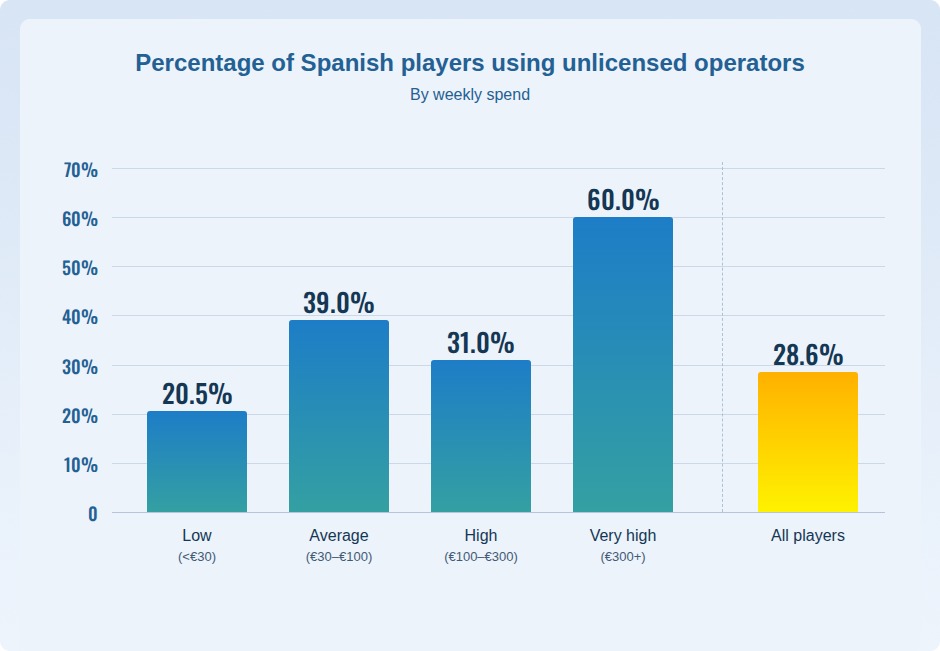
Across all players, 28.6% report using unlicensed operators at least some of the time. The share rises with spend, though not in a straight line: 20.5% among low spenders, 39.0% in the average band, 31.0% in the high band and 60.0% among very high spenders.
H2’s slides do not explain why the average band outscores the high band. They also give no base sizes, and the very high band is by construction the smallest group, so its figures carry the widest margin.
Most Spanish players do stay inside the licensed market. In the survey, 62.7% play only with licensed operators and 13.8% mostly do, while 7.5% split their play equally and 7.4% play mostly or only with unlicensed sites.
A further 8.7% do not know which kind of site they use. Almost one player in eleven cannot say whether the site taking their money holds a Spanish license.
Our July piece carried a lower number from a different source. In an EY survey for the trade body Jdigital, 23.4% of respondents had gambled on an unlicensed site at least once, and 9.3% knew it was unlicensed at the time.
H2’s 28.6% comes from a different sample and a differently worded question, so the gap cannot be read as a trend.
Asked why they use unlicensed operators, players give answers led by price and product. Better odds or pricing (24.4%), higher bonuses and free bets (19.7%) and a better product offering (17.5%) are the three largest shares.
Money and tax come next, with no tax on winnings (10.2%) and the ability to bet on credit (8.1%). Fewer customer checks (7.2%) and being blocked with licensed operators (6.7%) follow. Paying in cryptocurrency (6.2%) is last.
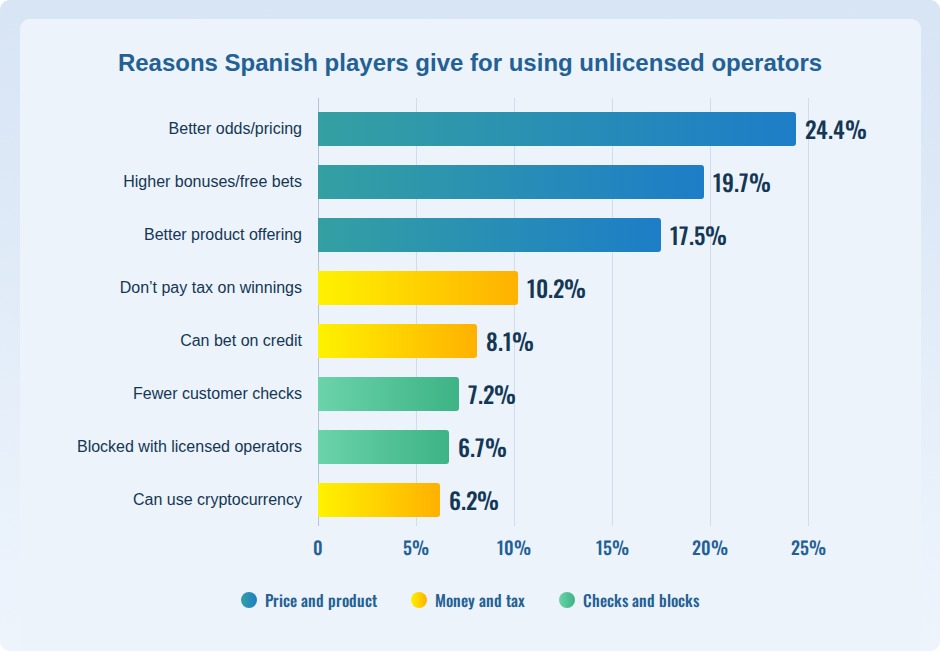
Two of those answers bear on the cap. Betting on credit means staking money that never passes through a deposit, so a deposit ceiling cannot see it. “Blocked with licensed operators” describes players the licensed system has already shut out, for whatever reason.
A deposit cap does nothing about odds, bonuses or product, which is where most of the pull comes from. Limits of this kind can push players toward unlicensed operators when the licensed offer is already the less attractive one.
The survey’s harm question is blunt: has gambling caused you financial difficulties in the past 12 months? The share answering yes climbs from 4.7% of low spenders to 11.0% in the average band and 21.4% in the high band.
Among very high spenders it is 26.7%, roughly 5.7 times the lowest band.
Account numbers point the same way at the top. Among very high spenders, 87% hold two or more online gambling accounts, against 54% of all players and 37% of low spenders. Those extra accounts are exactly the room a joint cap closes. Under per-operator limits, five accounts meant five ceilings.
H2’s 54% sits well above the DGOJ figure in our July piece, where 31% of active online players used more than one operator. One counts accounts held, the other operators used, and the samples differ.
| Weekly spend | 2+ accounts | Use unlicensed sites | Financial difficulty (past 12 months) |
|---|---|---|---|
| Low (under €30) | 37% | 20.5% | 4.7% |
| Average (€30 to €100) | 73% | 39.0% | 11.0% |
| High (€100 to €300) | 68% | 31.0% | 21.4% |
| Very high (€300 and above) | 87% | 60.0% | 26.7% |
| All players | 54% | 28.6% | not shown |
Source: H2 Gambling Capital player survey, October 2026. “Financial difficulty” is the share answering yes; the deck gives no all-player figure for that question and no base sizes.
On risk, then, the cap is aimed at the right group. It binds hardest on the band that reports the most financial difficulty and holds the most accounts.
The open question is whether those players stay inside the licensed system, where deposit limits, self-exclusion and operator monitoring can reach them, or follow the 60% of their band who already use unlicensed sites.
Channelization, the share of online gambling spend that stays with licensed operators, stood at 78.0% in Spain in 2025 on H2’s measure. The series peaked at 80.6% in 2022 and has drifted since.
H2’s forecast takes it to 77% in 2026, 75% in 2027 and 72% from 2028, with 71.3% by 2031. Behind the percentages, offshore GGR is forecast to grow 121% between 2025 and 2031, against 55% for the licensed market.
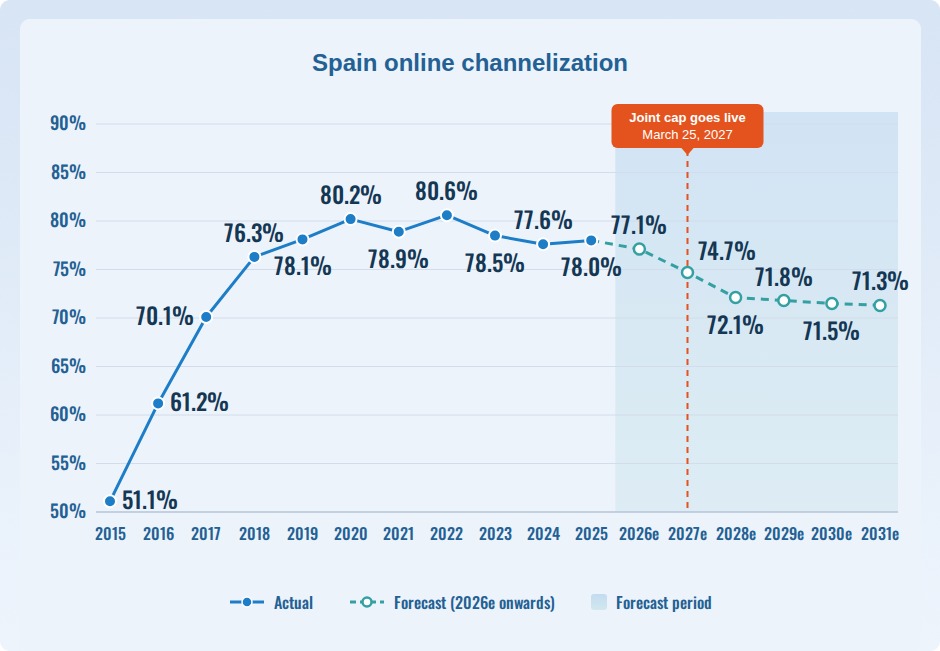
Five points may look small, but across the wider EU black market, every point that leaves the licensed system takes tax revenue and player protection with it.
It is also the wrong direction for a market that has kept adding players, with Spain’s rising player registrations up by more than a fifth in 2024.
On H2’s numbers the cap will do most of what it is designed to do. Around €220m of licensed spend is forecast to stop being gambled at all.
The rest is the cost. H2 expects about €80m to move where Spanish protections do not apply. The players it comes from belong to the group that already reports the most harm and the most unlicensed play. No limit, no self-exclusion register and no detection algorithm follows that money offshore.
What happens to those 15,000 players after March 25, 2027 will decide how the cap is judged. If most of them stay, Spain will have shown that a joint limit can bind high spenders without losing them. If they leave, the channelization line will show it first.
If gambling is causing you or someone you know difficulty in Spain, support can be accessed through the DGOJ’s safer gambling portal. Self-exclusion from every licensed operator is available through the national register, the RGIAJ.