
Article | 12 minutes read
Great Britain now has three years of comparable data on gambling harm. Six days after that milestone, the Gambling Commission changed where regulatory settlement funds go.
On July 16, 2026, the regulator published the third annual Gambling Survey for Great Britain (GSGB). It reported that 2.4% of adults surveyed scored 8 or more on the Problem Gambling Severity Index (PGSI).
On July 22, the Commission confirmed that regulatory settlement payments will be paid into the Consolidated Fund, the government’s account at the Bank of England.
The announcements did not reference one another. However, they describe one system from different angles: the surveys that measure gambling harm, and the funding that pays to reduce it.
The settlement decision is the more recent development, but it only makes sense in light of the funding rebuild that has been underway since 2025. Five dates set the frame.
| Date | Development | What it establishes |
|---|---|---|
| July 22, 2026 | Settlement funds directed to the Consolidated Fund | Payments in lieu of a financial penalty lose their presumed harm-reduction destination, effective immediately. |
| July 16, 2026 | GSGB 2025 annual report published | Of survey participants, 2.4% scored PGSI 8+; 59% gambled in the past 12 months; the first three-year comparable trend. |
| March 31, 2026 | GambleAware ceases operations | Removes the body that had been the presumed recipient of settlement money. |
| February 5–April 2, 2026 | Consultation on section 2.39 | 28 responses; just over half disagreed with the proposal to allocate settlement money to the Consolidated Fund. |
| April 6, 2025 | Statutory levy comes into force | Around £100 million a year for research, prevention, and treatment, funded by a percentage of operator GGY, commissioned by UKRI, OHID, NHS England, and the Scottish and Welsh governments. |
The GSGB survey covers Great Britain. Fieldwork ran across four quarterly waves between January 2025 and January 2026, collecting responses from 20,775 adults.
Participation edged down. Some 59% of survey participants gambled in the past 12 months, against 60% a year earlier. In the past four weeks, 47% gambled, falling to 27% once people who only played lottery draws are excluded.
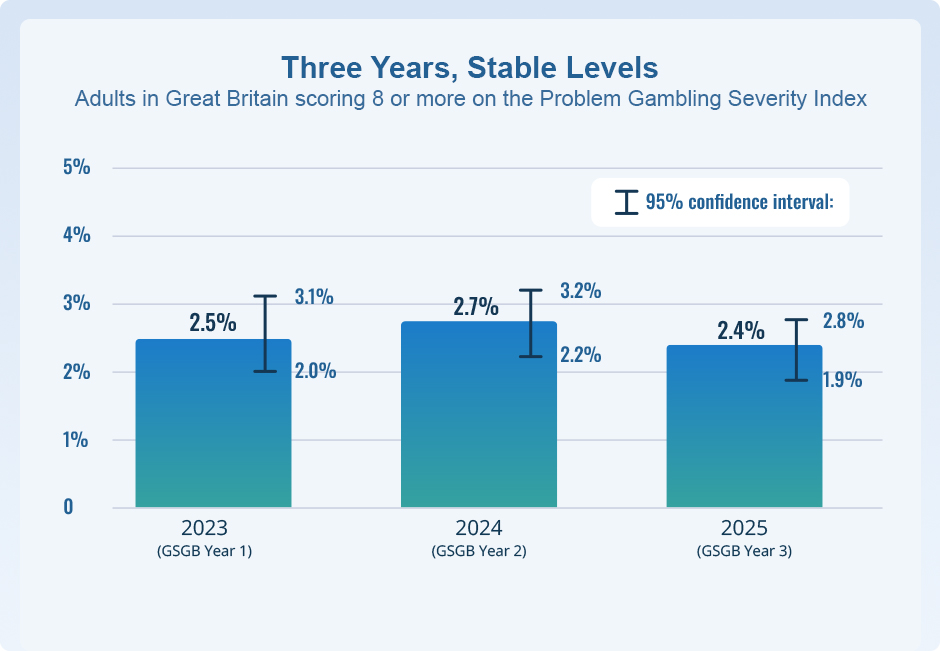
Among all participants, 2.4% scored 8 or more on the PGSI, the band the Commission labels problem gambling. A further 3.5% scored 3–7 (moderate risk), and 7.8% scored 1–2 (low risk).
Across the three reports, the headline harm measure has not changed significantly. The percentage of survey participants who scored PGSI 8 or more has remained stable:
The 95% confidence intervals for 2023 (2.0%–3.1%), 2024 (2.2%–3.2%), and 2025 (1.9%–2.8%) overlap substantially. That is why the Commission’s own summary calls the level stable rather than falling. The 0.3 percentage-point fall from 2024 to 2025 is within the survey’s margin of uncertainty and does not establish a downward trend.
One caveat belongs at the front of any reading of these numbers. The survey uses a push-to-web method, unlike the interviewer-administered health surveys that carried the PGSI before 2023, and the Commission is explicit about what follows.
Gambling Commission Note to editors accompanying the GSGB 2025 publication
Anyone placing 2.4% alongside a pre-2023 health survey figure is comparing two different instruments. The Commission’s technical report sets out the reasons in detail, including the risk that a survey advertised as about gambling oversamples people who gamble. That is also why the Commission advises against converting these percentages into a population headcount: the figures track the trend between waves, not the number of people affected.
Tim Miller Executive Director for Research and Policy, Gambling Commission
Financial penalties imposed under section 121 of the Gambling Act 2005 go to the Consolidated Fund. Regulatory settlements followed a separate route.
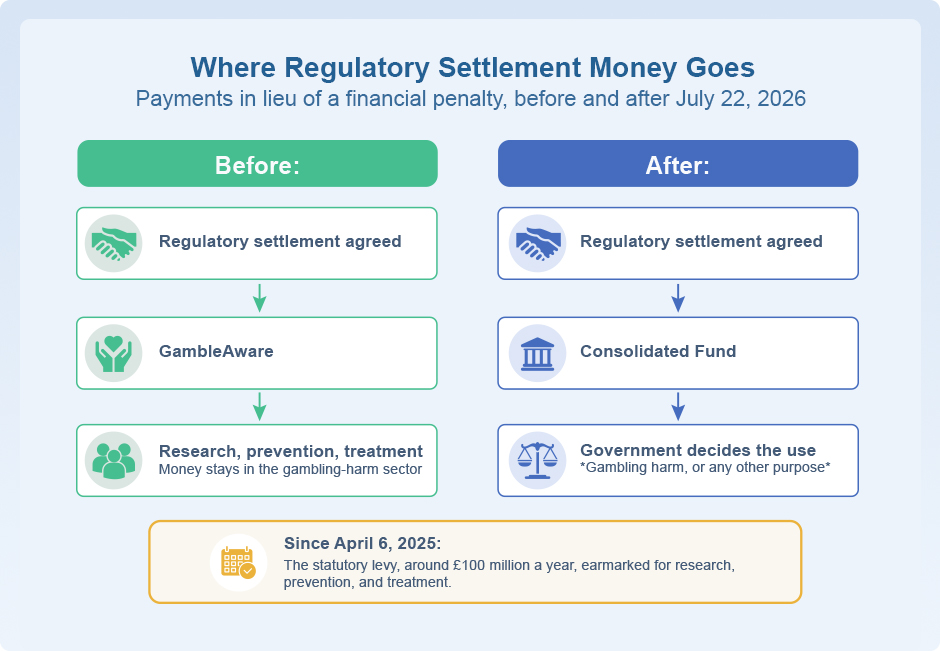
A regulatory settlement is a negotiated alternative to a penalty and may include a payment in lieu of a penalty. Under the old section 2.39, that payment did not go to the Consolidated Fund. The presumption was that it went to GambleAware for agreed purposes.
With GambleAware’s closure on March 31, 2026, the Commission was left with no automatic destination and an out-of-date rulebook.
Before consulting, the Commission worked through alternatives with the Department for Culture, Media and Sport. DCMS tested the idea of routing settlements through the commissioning bodies for the levy. The commissioning bodies pushed back.
That objection turns on how the two revenue streams behave. The levy is a fixed percentage of each operator’s gross gambling yield, charged annually on a sliding scale by sector, with remote operators paying the highest rate (1.1%) and arcades and society lotteries paying the lowest (0.1%). Commissioners can forecast it a year out. Settlement payments are made when individual enforcement cases conclude, in amounts negotiated on a case-by-case basis.
The consensus among UKRI, OHID, NHS England, and the Scottish and Welsh governments was that the complexity and volatility of settlement payments could pose significant challenges. The Commission and DCMS ruled out that option as unviable.
The amended section 2.39 is short. Payments in lieu of a financial penalty will be paid into the Consolidated Fund, in the same manner as penalties imposed under section 121. The amendment took effect immediately and applies to settlements finalized on or after July 22, 2026.
The money allocated to the Consolidated Fund is not ring-fenced for gambling-harm work. It becomes part of the government’s general revenues, with spending allocated through the normal government and parliamentary process.
Two of the largest settlements the Commission has reached show the scale: £19.2 million from William Hill Group businesses in 2023, and £17 million from Entain in 2022. Either figure alone is a substantial fraction of the roughly £100 million the levy raises annually.
The consultation on amending section 2.39 of the Statement of principles for determining financial penalties drew 28 responses from gambling businesses, charities, trade associations, a licensing authority, and members of the public. Just over half disagreed or strongly disagreed that funds should go to the Consolidated Fund. Around a third, mostly operators, agreed. The remainder held neutral views.
Supporters argued that no central body existed to receive and spend settlement money. Running settlements outside the levy structures, they said, would risk duplication and misalignment with agreed commissioning priorities. The Commission stated its position clearly.
Gambling Commission Consultation response on section 2.39
Opponents made a different argument. Their concern was that money would leave the gambling sector for non-gambling priorities. They also saw a break in the “polluter pays” link between a licensee’s failings and the harm caused.
Gambling Commission Summarizing respondents who opposed the proposal
Respondents proposed alternatives throughout the process, with some wanting settlements added to the levy fund. Others wanted a more flexible route that smaller charities and nonprofit organizations could reach, since many receive no direct levy funding. A few suggested ring-fencing settlement money inside the Consolidated Fund for gambling-harm work. That, the Commission noted, would be a decision for the government.
The Commission answered that deterrence comes from elsewhere: the actions a settlement requires of an operator, the size of the payment, and the publicity.
The 2.4% figure, the share of people who scored 8 or more on the PGSI, was measured under the old funding system, not the new one.
Fieldwork for the 2025 survey ran from January 2025 to January 2026. The statutory levy came into force partway through the fieldwork window, and GambleAware was still operating for the whole of it. In contrast, the 2023 and 2024 waves sit entirely inside the voluntary-contribution era.
So, the stability the Commission reports is a reading of the system that has just been replaced. No annual GSGB dataset yet covers a full year after both the levy transition and the Consolidated Fund decision.
The rest of the country’s 2026 reform program is on a similar timeline. A dedicated gambling harms research body launched the same day the Commission published its financial vulnerability check findings, earlier this year. The regulator has also been building direct evidence channels through its Consumer Voice research program.
Frontline services have been adapting too, as the shift from voluntary donations to statutory funding reshaped who commissions what.
Britain’s approach to intervening with individual players is also still changing. Our comparison of financial risk assessments in the UK and the Netherlands sets out where that stands.
Our read is that measurement is now the settled part of the system, while funding and intervention are not.
Three questions will eventually be answerable with evidence rather than argument. None of them can be answered yet.
The Commission will not evaluate this change on the grounds that it alters only a destination. That makes the levy’s first full commissioning cycle the place to look.
If you or someone you know is struggling with gambling, the National Gambling Helpline is free and open 24 hours a day on 0808 8020 133 in England and Scotland, or 0808 2819 265 in Wales. You can also contact helpline advisors through live chat at GamCare. Free self-exclusion from all UKGC-licensed online operators is available through Gamstop.