
Article | 12 minutes read

On 14 May 2026, UK Research and Innovation launched the £22.1 million GHR-UK Evidence Centre, while the Gambling Commission published its first findings on Financial Vulnerability Checks. Those two announcements indicate that 2026 is when the UK’s statutory levy began to visibly shape operator practice.
Two of the most consequential pieces of UK gambling policy in 2026 reached the public on the same day. UK Research and Innovation (UKRI) unveiled the Gambling Harms Research UK (GHR-UK) Evidence Centre, the largest independent gambling harms research body the country has seen.
Separately, the Gambling Commission published its first public look at how Financial Vulnerability Checks (FVCs) have been implemented since August 2024. Harmful gambling’s burden on the UK economy is conservatively estimated at around £1.4 billion per year, according to figures cited by UKRI.
Both press releases reveal the same evidence gap from opposite directions. UKRI is building the research capacity that the UK has lacked. The Gambling Commission is publishing early findings on rules that have already shifted to a tighter threshold without that research base in place.
What connects the two announcements is the statutory levy.
Both announcements trace back to the same source: the 2023 Gambling White Paper. It set out the case for replacing the patchwork of voluntary industry responsible gambling funding with a statutory levy on operators.
Under the Gambling Levy Regulations 2025, which commenced on 6 April 2025, rates are set at 1.1% of gross gambling yield for online operators. They scale down to 0.5% for land-based betting and casinos, 0.2% for non-remote bingo and adult gaming centres, and 0.1% for arcades and society lotteries. Projected annual yield is in the £90–100 million range.
The levy is split three ways:
UKRI’s launch statement reported that the 20% portion of the levy allocated to research amounts to £22.1 million for 2025–26. The GHR-UK Evidence Centre is the first major initiative funded through the research strand.
Financial Vulnerability Checks are the operator-facing lever from the same White Paper. While the levy directs money toward independent evidence, FVCs direct operator practice toward earlier identification of consumers in particularly vulnerable financial situations.
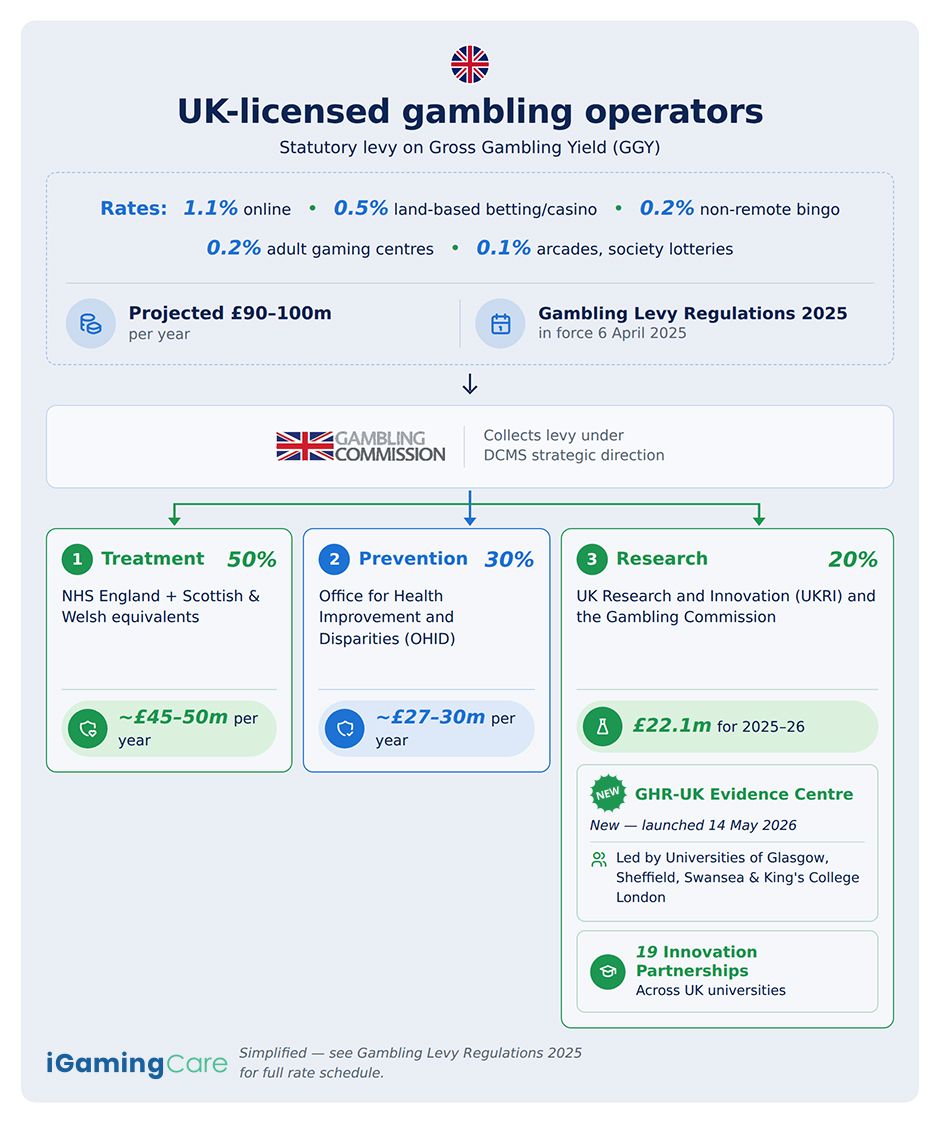
The GHR-UK Evidence Centre is led by Professor Heather Wardle of the University of Glasgow, with partner teams at King’s College London, Swansea University, and the University of Sheffield.
Its mandate includes a research program on gambling harms, capacity-building, and coordination of the 19 GHR-UK Innovation Partnerships already distributed across UK universities. Together, they make up the GHR-UK network.
It is the first UK gambling research centre to be fully insulated from industry funding. It replaces the voluntary funding mechanism that operated under the Licence Conditions and Codes of Practice. Independence from commercial gambling interests is, in UKRI’s words, “fundamental to the work of the Centre.”
Research priorities span three intersecting strands: gambling and sport, gambling in video games, and the structural drivers of harm. A separate future investment will examine the convergence between gambling and video gaming.
Martin Jones, appointed as lived-experience lead, brings direct personal insight into gambling-related suicide. He framed the Centre’s brief in stark terms:
Martin Jones, lived-experience lead, GHR-UK Evidence Centre
Meaningful research outputs are likely 1–2 years away. That timing matters for the second announcement.
Senior Policy Officer Sarah Webster and Senior Policy Evaluation Manager Richard Sutcliffe authored the UKGC’s blog post. It gives the first systematic view of how FVCs have been implemented since they became a requirement for remote gambling businesses in August 2024.
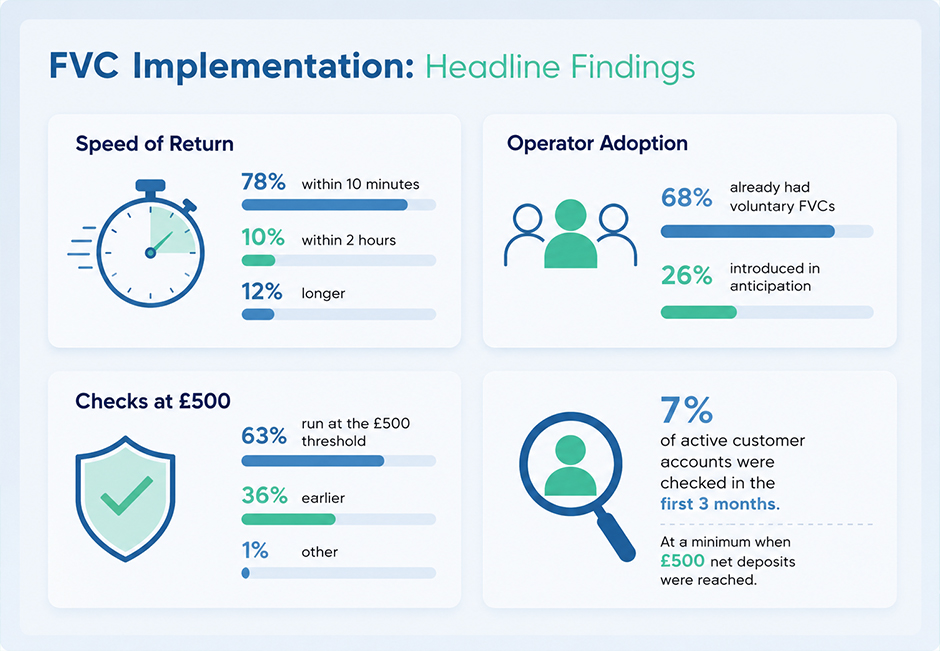
The FVC requirement was part of the UK’s broader compliance and consumer-protection push. The data comes from operators covering roughly 90% of consumers in Great Britain. Here are the headline numbers:
Most operators reported that the checks were well integrated into their existing processes. They confirmed the process produced positive effects, including more proactive engagement, earlier intervention with at-risk players, and better-quality customer interactions.
Some operators told the Commission they were receiving credit reference data as part of an FVC. However, the Commission said that such information cannot be shared through a financial vulnerability check. It suggested the responses were probably the result of a misunderstanding among those completing the data returns.
Whether the issue reflects a reporting error or a genuine classification gap, the Commission has since met with data providers to improve operator understanding. That is a quiet but significant signal that clarity over what FVCs include remains incomplete.
The Commission also issued a clear warning on automation. Some operators had built automated responses to individual County Court Judgments (CCJs), which could result in unnecessary friction where the risk marker is minor or there are no other indications of harm.
A smaller number of operators raised concerns about displacement to other operators when action followed a risk flag. The UKGC neither dismissed nor acted on the concern. Throughout, the Commission qualified its own findings:
UK Gambling Commission, FVC Insights blog (14 May 2026)
The data covers the £500 threshold, while the £150 threshold is already live.
That gap between when policy moves and when evidence arrives is the central theme. The Commission is studying £500-threshold data while the £150 threshold is already in force. UKRI is funding the research centre that will eventually validate or challenge current rules, with meaningful outputs several years away.
That is a natural consequence of reform moving faster than its evidence base. The 2023 White Paper made an explicit choice to act on harm reduction without waiting for a fully built research infrastructure. The levy’s research strand was always going to lag, by design.
The harder question is who decides what happens when independent evidence diverges from a live rule. That is the governance issue the GHR-UK Evidence Centre will eventually need to confront.
For operators and their compliance teams reading both releases that same morning, the operational implications fall into five categories:
The Commission has stated that it will release a full findings report on the £150 threshold. While the timing of the report has not been confirmed, operators should anticipate its arrival. NatCen’s wider evaluation of Gambling Act Review measures runs in parallel, providing a second evidence stream.
The Evidence Centre’s first commissioned outputs are expected in 2027–28. A future research levy strand focused on gambling-gaming convergence is already in scope.
The open question is governance. When the Centre eventually produces evidence that points one way, and the Commission’s live rules sit somewhere else, what process resolves the gap? Neither announcement on 14 May 2026 addressed that, and the answer will define the next phase of UK gambling reform.