Article | 9 minutes read
On March 25, 2027, Spain’s joint deposit cap takes effect. Every licensed operator will count a player’s deposits against the same default ceilings: €700 a day, €1,750 a week and €3,300 over four weeks.
H2 Gambling Capital expects the cap to take €300m out of licensed spend, measured against the forecast it made before the cap was approved. Of that, €220m is a net reduction in player spend and €80m moves to offshore operators.
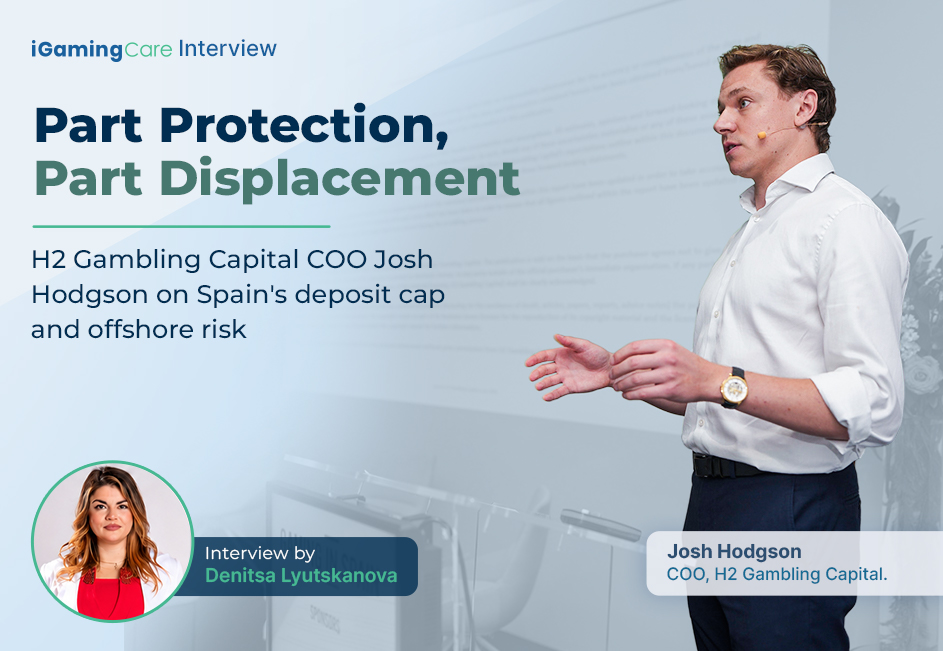
Josh Hodgson, COO of H2 Gambling Capital, presented the forecast at the Gaming in Spain Conference in Madrid on October 15, 2026. Our breakdown of H2’s data on Spain’s top 1% of players shows which spend bands most often use unlicensed sites and report the most financial difficulty.
Hodgson answered five questions for iGamingCare on what sits behind those figures. They cover the top 1%, whether the cap is working, how to win offshore players back, EY’s lower estimate and the lessons from Germany.
H2 tracks betting and gaming in 150 markets. Its Spain numbers are forecasts and modeled estimates, so we have added context from other sources after the answers. Hodgson’s answers have been lightly edited for clarity.
Two terms recur: GGR (gross gaming revenue, the amount players lose) and channelization, the share of gambling spend that stays with licensed operators.
Why do the top 1% of players matter so much for how the cap plays out?
Josh Hodgson: Based on previous disclosure from the regulator, the top 1% of players, roughly 15,000 people, generate just over 40% of online GGR in Spain.
That’s an average of around €4,900 of GGR per player per month, well above the €3,300 the new cap allows them to deposit every four weeks across all licensed operators combined.
For the vast majority of players the cap will make little or no difference, but for this small group it will bite hard. Whether they spend less, request higher limits or take their play offshore will largely determine the impact on the market.
Your forecast moves €80m offshore but cuts player spending by €220m. Is the cap working, or is it backfiring?
Josh Hodgson: It will achieve part of what it sets out to do, but at a cost.
Of the €300m we expect to leave the licensed market, €220m is a genuine reduction in player spend, which is the policy’s intended outcome.
But the remaining €80m moves to operators offering no player protection at all, and it’s the highest-spending players, who are also the most likely to report financial difficulty, who are most likely to make that move.
In our view, targeted interventions based on behavioral indicators, with the regulator setting the standards and auditing the results, protect at-risk players more effectively than blanket financial limits, and Spain’s mandatory risk-detection algorithm is a step in that direction.
However, it remains to be seen exactly how that will work and ultimately how effective it will be.
60% of €300+/week players already use unlicensed sites. What would bring them back?
Josh Hodgson: These players aren’t going offshore by accident. They’re going for value.
Better odds, bigger bonuses and a broader product are the three main reasons players gave in our survey for using unlicensed sites, and 10% cite not paying tax on their winnings.
Bringing them back means a licensed product that can compete on value, backed by stronger enforcement, particularly on payments, and clearer communication of the difference between licensed and unlicensed sites.
The risk is that the deposit cap moves things in the opposite direction for exactly this group by adding another layer of friction, and therefore another reason, to leave the market.
Why are your offshore figures higher than EY’s €231m estimate?
Josh Hodgson: The EY study is a valuable contribution to the debate, and different methodologies will always produce different numbers.
Ours combines monthly web traffic, affiliate traffic and search data with in-depth player surveys, rather than relying on survey responses alone.
We’ve tracked this in 150 markets for 16 years now and honed that methodology with in-depth research and benchmarking into the impact of various regulatory interventions as well.
One thing we note with just using survey data like in the EY report is that self-reported spend tends to understate offshore activity. EY’s own research found that many players use unlicensed sites without realizing it, so they’re unlikely to report that spend.
It’s also important to compare like with like on definitions and the year covered: EY’s estimate relates to 2024, whereas we put offshore online GGR at around €490m in 2025.
What should Spain take from Germany’s experience before the cap goes live in March 2027?
Josh Hodgson: Germany is the clearest warning for Spain here.
It has had a €1,000 monthly cross-operator deposit limit since 2021, alongside stake limits on slots and a tax on stakes, and we currently estimate its online channelization at 49%, compared with around 77% in Spain at the moment. However, we forecast [Spain’s figure] to drop to 72% by 2028 as a result of the limits.
Furthermore, if we exclude betting and look specifically at gaming channelization for Germany, where most of the restrictions are placed, it’s at 30%. That is a very clear warning sign that a policy sending 70% of player spend to unregulated offshore operators has gone drastically wrong.
Spain’s cap is more generous and doesn’t come with the same product restrictions, so it’s not a like-for-like comparison.
But the lesson is clear: when the licensed product becomes significantly less attractive, high-value players don’t stop gambling. They go elsewhere and, unfortunately, that is outside of the very regulatory framework that’s been designed to keep them safe.
Just as a final thought, we think that how flexibly Spain handles requests for higher limits will be a critical factor in how this plays out.
The cap’s default four-week ceiling of €3,300 works out at about €3,590 per calendar month. Against the €4,900 average Hodgson cites for the top 1%, that narrows the gap without closing it. GGR measures losses, not deposits, so the comparison is indicative.
Hodgson says it remains to be seen how Spain’s risk-detection mechanism will work in practice. It is still a draft. The DGOJ, Spain’s gambling regulator, held a second public consultation on a resolution that would make a common detection mechanism mandatory for licensed operators. Comments closed on October 26.
As Hodgson explains, H2’s offshore figure (about €490m for 2025) and EY’s €231m (for 2024) use different methods and cover different years. We have not seen the underlying data for either. Our comparison of deposit caps in Spain and Germany covers the EY study.
H2’s 49% for Germany’s online channelization, presented in Madrid, is consistent with other published estimates of Germany’s black market that put it at around half or more.
By contrast, a study commissioned by the GGL, Germany’s regulator, put the licensed share at 77% for 2024. The 30% Hodgson gives for gaming alone is a narrower cut that excludes betting.
Germany’s rules continue to develop. The €1,000 monthly deposit limit has stood since 2021. On July 1, 2026, Germany began letting operators offer tiered slot stakes of up to €5, with €1 still the ceiling for under-21s.
Hodgson closes on how flexibly Spain handles requests for higher limits. Under Royal Decree 520/2026, players can raise or remove the defaults after reinforced risk information and a three-working-day wait. Increases are limited to once every three months.
How readily the top 1% use that route will affect how many of them stay with licensed operators. The first evidence arrives after March 25, 2027, in licensed revenue figures and in new estimates of offshore play.