Article | 12 minutes read
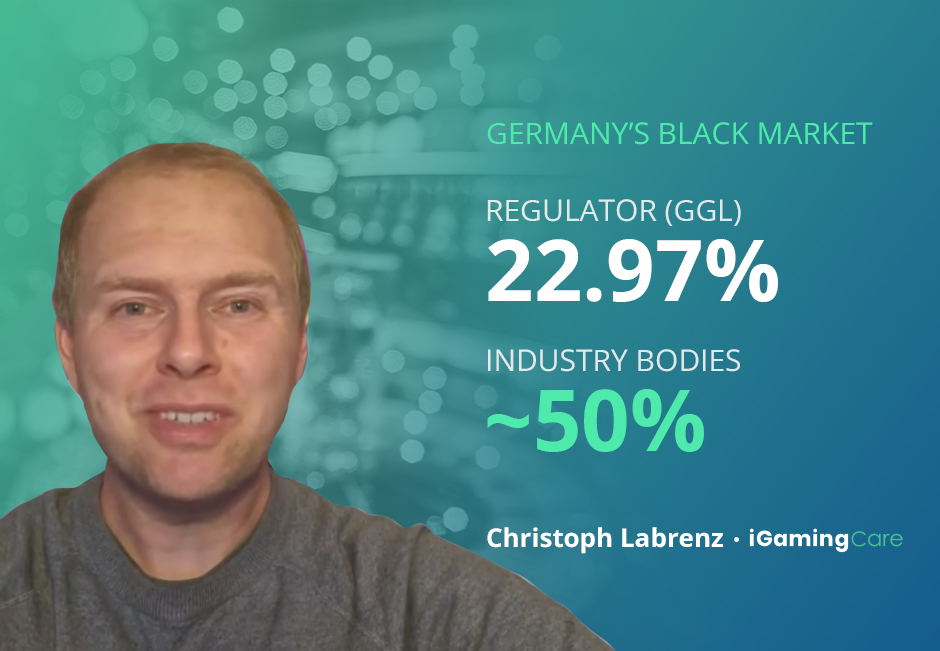
Germany’s gambling regulator puts the licensed share of the online market at 77.03%. The trade bodies whose members hold those licenses say the real figure is closer to half. One market, two irreconcilable pictures of it.
Christoph Labrenz of iGaming.com breaks down the numbers in the video.
In September 2026, Frankfurt prosecutors said one alleged operator group had processed around €5.86 billion in stakes across its sites. What follows lines up the main published estimates of Germany’s black market and tests each against that case.
No agreed figure exists. Germany’s Joint Gambling Authority of the Federal States (GGL) commissioned a study putting unlicensed operators at 22.97% of reported player losses online. That was worth €547 million in gross gaming revenue in 2024.
Industry bodies, market analysts, and a German tax court put the illegal share at roughly half or higher. On one licensed operator’s arithmetic, a single criminal case equals about 27% of the virtual slot volume that tax data can quantify.
Channelization is the share of gambling activity that stays inside the licensed market. Across Europe it runs from 93% in the UK to 23% in Norway, a 70-point spread across national channelization rates. Germany has no settled version of its own number.
| Source | Period or date | Method | Black-market share | Legal share (channelization) |
|---|---|---|---|---|
| GGL study, by Blockchain Research Lab | 2024 data, published March 16, 2026 | Panel survey of 2,000 online gamblers, measuring reported losses. Other methods were reviewed but not used for the estimate | 22.97% (€547m GGR) | 77.03% |
| GGL, prior-year comparison | 2023 data | Same regulator basis | €466m GGR, the base the 2024 figure rose 17% from | Not published as a percentage |
| DOCV-commissioned study (Gunther Schnabl, University of Leipzig) | Published November 2023, restated March 2026 | Nielsen usage panel plus stake analysis. The trade body states the result as roughly half | About 50% | About 50% |
| DOCV, citing Nielsen data | Cited September 2026 | Nielsen gambling activity panel | About 56%, basis not stated | Not published |
| DOCV, online slots only | Estimate given January 2025 | Academic estimates cited by the trade body | 60% to 80% | 20% to 40% |
| Frankfurt case, per Marcel Freiberger’s calculation | 2024 tax loss | Alleged shortfall set against national virtual slot tax receipts | 26.7% of quantifiable virtual slot volume, from one investigation | Not applicable |
Table note: the rows measure different things, some cover the whole market, others only slots. Revenue shares, usage shares, player shares and tax-base shares are not interchangeable, and the second column mixes measurement periods with publication dates where a source gives only the latter.
On Tuesday September 8, 2026, more than 100 officers searched 11 premises. Most were in the Rhine-Main area, focused on Frankfurt, with others in Cologne. Prosecutors announced the operation the next day.
Four authorities ran it together: Frankfurt prosecutors, tax investigators, North Rhine-Westphalia’s financial-crime office, and Frankfurt police. Five people are under suspicion. Investigators executed one arrest warrant and froze about €82 million in assets.
Between July 2021 and the end of 2023, prosecutors say the sites processed around €5.86 billion in stakes. Separately, they put the alleged tax shortfall at about €77.6 million for 2024 alone.
Spread evenly across those 30 months, €5.86 billion works out at roughly €4,500 a minute. Christoph Labrenz reaches a similar per-minute figure in the video above. He also puts the tax loss at around a third of the legal slot market’s annual virtual slot tax.
Prof. Dr. Andreas Ditsche, CEO of iGaming.com, has said that alongside the alleged group, tens of thousands of players may have been gambling illegally. None of the allegations has been tested in court.
Marcel Freiberger, Head of Online & Public Relations at licensed German operator Löwen Play Digital, set the arithmetic out publicly in a LinkedIn post. Germany’s virtual slot tax raised about €213.5 million in 2024. Against that, the alleged shortfall gives 77.6 / (213.5 + 77.6) = 26.7%.
Freiberger states the assumption the calculation rests on: that the whole alleged shortfall falls on the virtual slot tax. His post stops there. Run the shortfall back through the 5.3% turnover tax and the 2024 staking volume comes out near €1.5 billion.
What the figure produces is a share, not a market size. On his arithmetic, one investigation accounts for roughly a quarter of the virtual slot play Germany can see in its tax receipts. Every other unlicensed site sits outside it.
“It is fair to ask whether reality is perhaps somewhat less channeled than 77.03%, quoted to two decimal places, suggests. The black market, at any rate, does not always seem to respect statistical precision.”
Marcel Freiberger, Head of Online & Public Relations at Löwen Play Digital (translated from German)
Labrenz’s “around a third” and Freiberger’s 26.7% are not the same measurement. One sets the loss against tax collected, the other against tax collected plus tax allegedly lost.
The GGL study did not count illegal wagers. It asked about them. Researchers at the Blockchain Research Lab put the question to 2,000 people with a year of online gambling behind them, excluding lottery play.
Each participant could list as many as seven sites, with a stake and a loss figure for each. The research team checked those sites against the GGL whitelist and split the spending in two. The result is measured in euros rather than players.
That method has an obvious soft spot. People asked whether they gamble on illegal sites have reasons not to say yes. The DOCV calls the sampling “non-representative” and points to recall bias.
“The numbers are not consistent with the observed tax numbers we know.”
Simon Priglinger-Simader, Vice President, Deutscher Online Casinoverband (DOCV)
The incentive runs both ways. A larger black market is the sector’s best argument for loosening the limits its members operate under. The smaller figure is the regulator’s best argument against.
GGL board member Ronald Benter framed the result more cautiously than the headline number suggests, saying it confirms the authority’s existing assumptions. The findings now feed the treaty evaluation, alongside a player-protection study still underway.
Against that sits the industry’s counter-data. A DOCV-commissioned study published in November 2023 landed at roughly half. Economist Gunther Schnabl of the University of Leipzig wrote it from Nielsen activity data.
In September 2026 the association cited Nielsen figures putting the unlicensed share nearer 56%. That figure reaches the public as a trade-body citation. The underlying study has never been released, and its sampling has not been opened to review.
Operators blame the same four rules. Two are product limits: the five-second average minimum spin and a per-spin stake cap fixed at €1 until July 2026. Two are financial: the 5.3% turnover tax on stakes and the €1,000 monthly deposit limit. Each has been argued over at length in the debate about whether overregulation moves players offshore.
Section 32 of the 2021 Interstate Treaty (Glücksspielstaatsvertrag 2021 – GlüStV 2021) requires a report by December 31, 2026. It is the first full review since the treaty took effect, with channelization at its center.
One move has already been made. Effective July 1, 2026, the GGL used its Section 22a(7) power to let operators depart from the €1 per-spin cap for individual players.
The €1 limit stays the statutory default. Players aged 21 and over can be granted up to €3. The €5 tier requires 90 days without addiction indicators, plus continued monitoring afterward.
No player is entitled to an increase. Offering one is voluntary for operators, and the whole regime expires on December 31, 2027. iGamingCare has looked at what a €5 maximum stake does to player losses.
“Licenses for online casino games have to date barely been granted in the individual federal states, which is why online casino games take place almost exclusively in the black market. The evaluation of the Interstate Treaty must therefore set a nationwide licensing model for online casino games in motion.”
Kevin O’Neal, Board Member, Deutscher Online Casinoverband (DOCV) (translated from German)
The DOCV also wants the criminal provisions updated for cross-border offers, so the place of the offense follows the player’s location in Germany. The DSWV’s priority is narrower: sustained enforcement.
Freiberger’s request is the narrowest. He wants the new tax and investigation data fed into the channelization assessment itself.
Every protection in the German treaty stops at the license boundary. On a licensed German site, a player has:
Every protection listed here applies on a licensed German site only. Which side a site sits on is checkable. The GGL publishes a whitelist of every operator licensed in Germany.
Offshore, none of it applies. A player who moves does not shed those protections one at a time. They lose the whole set at once, which is what happens when Germany’s monthly deposit limits push players toward the black market.
Mathias Dahms, president of the DSWV, made the same point after the September operation. His list of what an unlicensed site lacks was short. No deposit ceiling, no identity check, no way to suspend an account.
“Anyone who wants to strengthen player protection must therefore consistently crack down on illegal services and strengthen legal ones.”
Mathias Dahms, President, Deutscher Sportwettenverband (DSWV)
Freiberger frames the test the same way from the operator side. He judges regulation by how many players it actually reaches.
The estimates disagree about size. None disagrees that a substantial German audience plays where no German rule applies.
Behind every percentage point in that table sits a group of people. For them the deposit limit, the exclusion register, and the harm-detection system do not exist. Sizing the black market is a way of counting them.
In Germany, if gambling is causing problems for you or someone you know, the BIÖG counseling line is free and anonymous on 0800 1 37 27 00. Information, self-tests, and support resources are also available in the iGamingCare hub.