Article | 8 minutes read

Only two European countries have now adopted online gambling deposit caps that apply to every licensed operator rather than site by site. In the space of eight days, the two moved in opposite directions.
Spain’s Council of Ministers approved the country’s first market-wide deposit cap on June 23, 2026. It includes one set of ceilings, counted across every account a player holds. Germany has run that model since 2021. On July 1, it raised the maximum online slot stake from €1 to as much as €5 per spin.
One market is tightening the ceiling. The other is testing whether a small opening keeps players inside the licensed system. Together, they form the clearest live experiment in how far limits can go before players look elsewhere.
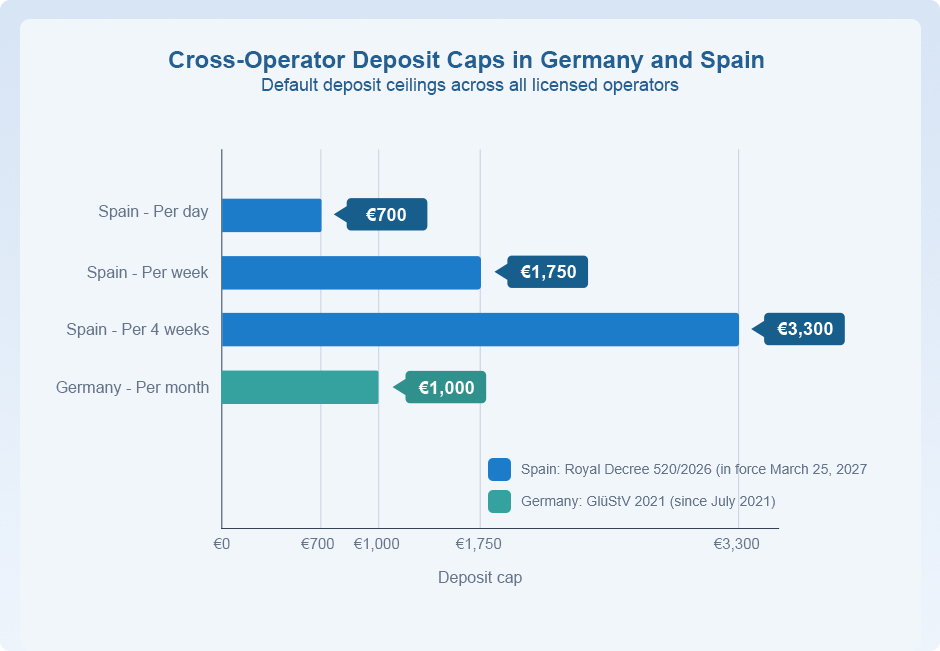
Royal Decree 520/2026 introduces joint deposit limits across all online gambling operators: límites conjuntos de depósito. The defaults are:
The ceilings count every licensed account together. Once combined deposits hit €700 in a day, no licensed operator will be allowed to accept more until the period resets.
The reform closes a simple loophole. Spain’s existing limits, €600 per day, €1,500 per week, and €3,000 per month, apply separately at each operator. That means a player with five accounts could have €15,000 in monthly deposit room. The joint cap removes that multiplier.
That makes Spain the second European market, after Germany, to adopt a deposit ceiling covering its whole licensed sector rather than operator by operator.
According to figures from the Directorate-General for Gambling Regulation (DGOJ) cited by the ministry, 31% of active online players in Spain use more than one operator.
Ministry of Social Rights, Consumer Affairs and 2030 Agenda (translated from Spanish)
The defaults can be raised, but not casually. A player seeking more headroom faces reinforced risk warnings and a three-working-day wait before any increase applies; reductions take effect immediately.
Nothing switches on until the DGOJ has working infrastructure: a central registry that every licensed operator queries at the moment of deposit. The decree gives Spain’s regulator nine months. Joint limits become mandatory on March 25, 2027; a trial version is due to operators around September 2026.
Germany has run Europe’s original cross-operator deposit cap since the Interstate Treaty on Gambling (GlüStV 2021) came into force in July 2021. Licensed operators feed every deposit into LUGAS, a central monitoring system operated by the Gemeinsame Glücksspielbehörde der Länder (GGL). The default ceiling is €1,000 per month across all providers combined.
The gap between the two models is stark. At Spain’s defaults, a player could deposit Germany’s entire monthly allowance within two days and still have €2,300 of four-week headroom left. Germany’s ceiling, meanwhile, is a widely cited example of how strict limits can produce unintended consequences that drive players to the black market.
German players can apply to raise the ceiling, but the bar is high:
How many players clear that bar is not published. What is documented is where German players go instead. Estimates of the licensed market’s share of online play vary widely. A GGL-commissioned study found 77%; industry figures put channelization at 50% or less. The dispute plays out even in search behavior around gambling legality in Spain and Germany.
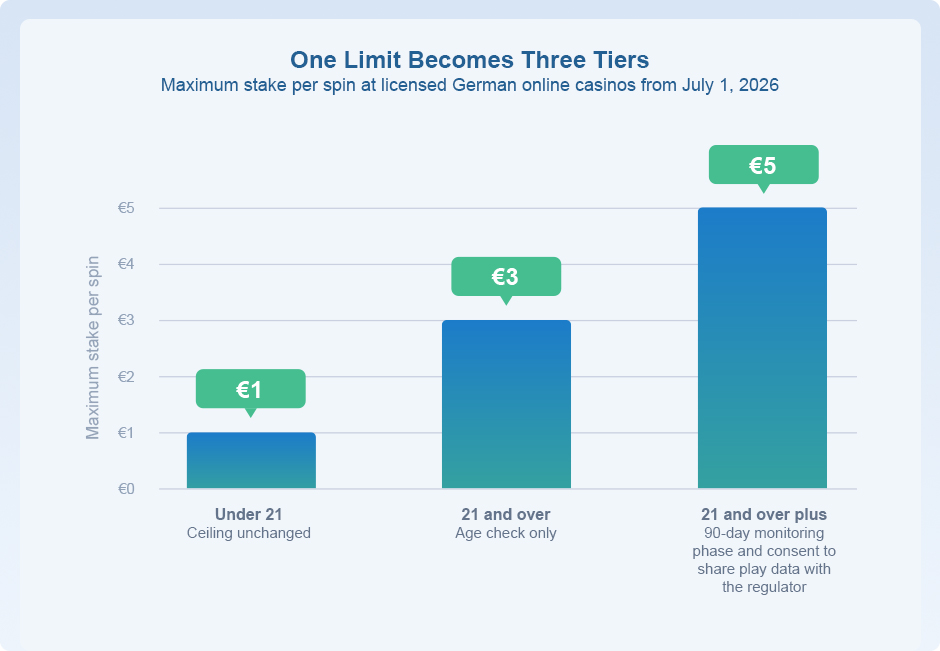
Germany’s second move is the one operators have waited five years for. Since July 1, 2026, licensed slot sites may exceed the €1-per-spin ceiling set by the 2021 treaty. Under the new tiered model, online slot stakes can now reach €5, but only for players who meet age, monitoring, and consent requirements.
The change arrived quietly, implemented and supervised by the GGL. The regulator sent an official letter to operators the day before the new rule’s effective date. No public press release has yet been issued. Licensed operators’ own player-information pages remain the clearest public record of the rules:
The €5 tier must be earned. To play with those stakes, a player must first successfully complete 90 days of behavioral monitoring. Only if that phase raises no flags and the player expressly consents to keep sharing play data with the regulator does the top stake unlock. The data sharing is intended to detect potential signs of problem gambling behavior early and protect players.
The five-second minimum average spin duration and the €1,000 monthly deposit cap remain unchanged.
At iGB L!VE in London on July 1, the day the tiers went live, iGaming.com canvassed operators active in the German market and expectations are modest.
Almost none expect a reversal of the drift that pushes European players toward unlicensed sites. Several argued that only a cut to Germany’s 5.3% tax on slot stakes would move that needle. More likely, they said, budgets stay pinned by the €1,000 deposit wall and simply run out sooner. Whether losses per player climb from there is the open question.
Prof. Dr. Andreas Ditsche CEO, iGaming.com
The comparison is not simply about which country sets the higher number. Spain and Germany are using the same regulatory instrument, a cross-operator deposit cap, to answer different policy questions. Spain is trying to close the multi-account loophole to protect players without setting a ceiling as low as Germany’s. Germany, meanwhile, is keeping its strict monthly deposit wall while loosening stake limits in a controlled way.
| Metric | Spain (RD 520/2026) | Germany (GlüStV 2021) |
|---|---|---|
| Default cross-operator deposit cap | €700/day, €1,750/week, €3,300/4 weeks | €1,000/month |
| Per-operator layer | €600/day, €1,500/week, €3,000/month (unchanged) | No statutory per-operator default |
| Central system | DGOJ real-time tool (in development) | LUGAS Limitdatei, run by the GGL |
| Adjustable? | Yes: increases after a 3-working-day reflection period | Yes: up to €10,000/€30,000 with proof of financial capacity |
| Max online slot stake | No statutory per-spin cap | €1 / €3 / €5 tiered by age and monitoring |
| Status | Approved June 2026; live March 25, 2027 | Deposit cap since July 2021; €5 stakes since July 1, 2026 |
Placed side by side, the two systems show how much design matters. The headline cap, the central monitoring tool, and the surrounding product rules all shape whether a limit protects players and preserves channelization, or pushes too much activity outside the licensed market.
Spain’s industry is not disputing the goal of the cross-operator deposit caps. It disputes the evidence. Jdigital, the trade association for licensed online operators, says it views the decree with “concern.” In the association’s view, the government has asserted, not demonstrated, the measure’s “necessity and proportionality.”
Citing DGOJ data, Jdigital says around 80% of Spanish online players use a single operator, framing the rule as one that “affects a very small segment of the market.” The ministry counts a different group: among active online players, 31%, roughly a third, use more than one site. The gap between those two framings is where the legal argument will live.
Displacement is the sharper warning. In an EY survey commissioned by Jdigital, nearly one respondent in four (23.4%) reported at least one session on an unlicensed site. Of all respondents, 9.3% knew the site was unlicensed when they played.
EY sized Spain’s illegal online market at €231 million for 2024, around a sixth of licensed revenue. Whether deposit caps feed that number is the question Germany’s experience keeps raising, and a familiar one across Europe’s patchwork of limits, levies and legal loopholes.
There is precedent for a challenge. In April 2024, Spain’s Supreme Court annulled several provisions of the 2020 advertising decree. Curbs of that severity, the court held, could not rest on secondary regulation alone and had to pass a proportionality test. The deposit decree took the same legal route: a royal decree, not a law passed through Parliament.
No other European market currently enforces a deposit cap across its whole licensed sector. The tool exists almost everywhere, on a per-operator basis:
Mandatory limit-setting is spreading across the continent. Forcing a single number onto the whole market, though, remains a two-country experiment.
Both countries have, in effect, put their theories on the clock. Germany’s data will start arriving first. Its stake-tax receipts should make any shift in licensed slot play visible within months.
Spain has until March 2027 to build its system. It must also convince a skeptical industry that a cap roughly 3.3 times looser than Germany’s can protect players without repeating Germany’s channelization problem.