
Article | 12 minutes read

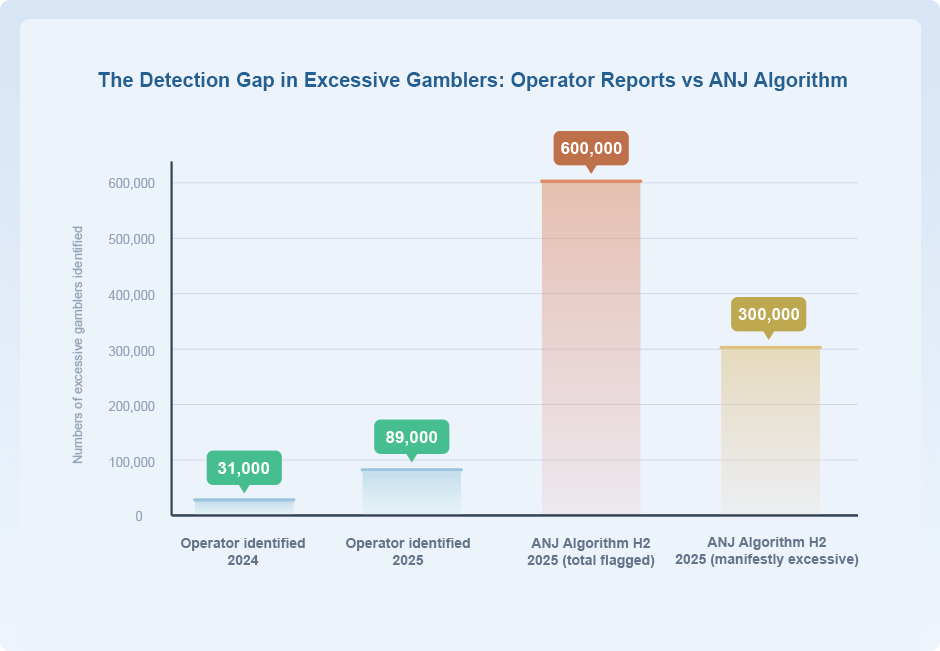
France’s licensed gambling operators identified 89,000 excessive players in 2025, nearly triple their 2024 figure of 31,000. On paper, that appears to be real progress.
The national regulator’s new algorithm estimates the actual number nearly seven times higher: around 600,000 players, generating an estimated €1.2 billion in gross gaming revenue, or 60% of all online GGR. That share has been climbing steadily since 2023.
The gap between the two numbers is significant. It is not an operator failure; it is a measurement mismatch. France’s regulator has just made its own model the public benchmark.
On 13 May 2026, France’s national gambling regulator, l’Autorité Nationale des Jeux (ANJ), released the first results from a detection algorithm developed under its 2024–2026 strategic plan.
The algorithm uses continuous, account-level gambling data that licensed operators are required to transmit to the regulator. It includes data from the two national operators with single-account systems: La Française des Jeux (FDJ) and Pari Mutuel Urbain (PMU).
The headline numbers from the second half of 2025:
The ANJ noted that the number of excessive players had grown faster than the overall player base, ruling out market expansion alone as the explanation.
The model is built on 23 indicators drawn from scientific literature, covering four categories:
Each player receives a single score, which classifies them into one of four groups: recreational, moderate risk, excessive, or manifestly excessive. The ANJ confirmed the algorithm’s performance was validated against the internationally recognized Canadian Problem Gambling Index (CPGI) and vetted by an independent scientific committee.
The ANJ describes it as the first such model available in Europe, with similar projects underway in Spain and the Netherlands. The model does not provide an exact prevalence measure, but it does give France with a real-time benchmark against which operator-reported numbers can be compared.
Isabelle Falque-Pierrotin, ANJ President
For operators, the algorithm is offered as an optional “compliance barometer”. It offers a way to evaluate whether their own identification efforts are at the right level. For the ANJ itself, it serves as a reference point for tracking trends and assessing the effectiveness of prevention efforts.
The gap between what operators report and what the regulator measures is now the central tension in French gambling oversight.
| Identification Source | Excessive Players (Online) |
|---|---|
| Operator self-reports — 2024 | 31,000 |
| Operator self-reports — 2025 | 89,000 |
| ANJ algorithm — H2 2025 (all flagged) | 600,000 |
| Of which “manifestly excessive” | 300,000 |
| French Monitoring Centre for Drugs and Drug Addiction (2024, all gambling) | 360,000 |
The contrast between 89,000 and 600,000 is striking on its own. In addition, the French Monitoring Centre for Drugs and Drug Addiction estimated that approximately 1.17 million people in France in 2024 exhibited problematic gambling behavior. Of those, roughly 360,000 were classified as excessive players.
The ANJ’s algorithm focuses only on the online and account-based population, but its 600,000 figure already exceeds the Monitoring Centre’s whole-market estimate of excessive players. That underlines how online play has become the dominant channel for harm.
The regulator is now using the algorithm to set the objective level of effort it expects from operators. In plain terms: subjective compliance is over. The ANJ has established a benchmark, and it expects the industry’s identification efforts to converge with it.
The algorithm announcement should not be viewed in isolation. Five weeks earlier, on 8 April 2026, the ANJ published its annual review of the prevention action plans submitted by every licensed gambling operator in France. The plans covered the period from November 2025 to March 2026. The review’s findings provide essential context for the algorithm announcement.
Headline findings:
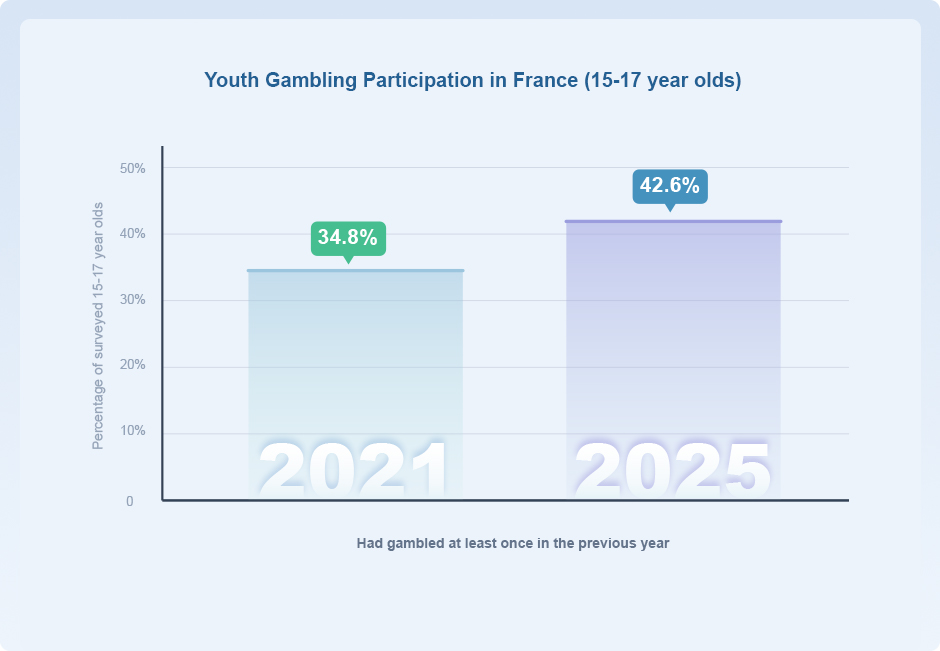
The underage participation data is particularly concerning. According to the ARPEJ ENJEU-Mineurs survey in 2025, 42.6% of 15–17-year-olds (among 5,000 respondents) had gambled at least once in the previous year. That was an increase of nearly 8% from 2021, despite a strict legal ban. That mirrors a pattern seen across European jurisdictions where youth gambling is rising even as regulators tighten the rules.
The ANJ pressed racecourse operators to separate family areas from betting zones. It also called for a whistle-to-whistle ban on gambling advertising during the 2026 FIFA World Cup. In 2024, the regulator concluded that Polymarket’s services “could constitute unauthorized gambling,” warning that prediction market platforms “are not authorized in France and are considered illegal gambling services.”
The 60% figure is uncomfortable for the industry. If a small share of the player base generates the majority of the revenue, the commercial model becomes structurally dependent on harm. A similar concentration problem is visible across multiple jurisdictions. Still, France is the first market where the regulator has built its own measurement infrastructure.
Three things follow:
France’s regulated gambling market expanded by 3% in 2025, reaching €14.1 billion in total GGR. On its current trajectory, the share of online revenue coming from algorithm-flagged players is rising. That is not the kind of growth profile any regulator wants to defend in front of a 2027 reduction target.
Most European regulators currently rely on operator self-reporting backed by periodic population surveys, methods that yield numbers like the 89,000 used by France before. The ANJ has just shifted to real-time, algorithm-based identification at the regulator level, validated against an internationally accepted index.
Spain and the Netherlands are working on similar tools. If those projects come to fruition, the longstanding problem of fragmented player protection measurement across Europe may finally start to converge on a shared evidence base.
For French operators, however, the immediate question is not what happens at the European level. It is what happens at the next annual review. The gap between their self-reported numbers and the ANJ’s algorithm-detected numbers will, for the first time, sit on the same page.