Article | 12 minutes read

Regulating gambling ads has always been challenging, and the data proves it. The University of Cambridge has found that gambling ads in Ireland reach more than twice as many men as women, even when campaigns are gender-neutral. Yet stricter rules aren’t always the answer: Italy may lift a ban in place since 2018 on gambling advertising, which has pushed players toward illegal offshore sites.
Research from the University of Cambridge, published in April 2026, shows that gambling ads on social media reach young men, who are known to be at the highest risk of problem gambling, more than twice as often as they reach women. The study analyzed 411 advertisements from 88 licensed gambling sites and found that the most exposed group was people aged 25 to 34.
In Ireland, the new framework restricts social media gambling ads so adult users generally need to opt in to receive them. The situation is different in the UK and most other European countries, while the US is affected by prediction markets such as Polymarket and Kalshi.
Even when gambling ads were gender-neutral, they still reached more vulnerable young men than women. Previous research shows that the more exposed a person is to gambling advertising, the more likely they are to be affected by gambling harm.
Meta Ad Library was used for the study. Meta, like other large platforms, is obliged to publish all advertising displayed on its platforms under the EU Digital Services Act (DSA).
| Key Takeaways from the Cambridge Study | |
|---|---|
| Ads analyzed | 411 |
| Licensed operators covered | 88 |
| Male accounts reached | 12.6 million |
| Female accounts reached | 5.4 million |
| Most exposed age group | 25–34 |
| Impressions among ages 25–34 | 6.2 million |
| Ads targeting men only | 91 |
| Ads targeting women only | 0 |
Dr Elena Petrovskaya from Cambridge’s Department of Computer Science and Technology shared: “Even in a country like Ireland with a small population, the number of accounts these ads reached was dizzying. We looked at Ireland as a case study of an environment where a modern gambling regulatory framework had not yet been adopted.”
Ireland’s Gambling Regulation Act 2024, which took effect in March 2025, includes provisions to introduce a watershed for broadcast advertising. The provisions are still pending, but if they pass, registered users of licensed platforms will be able to limit the gambling ads shown to them on social media.
Italy’s gambling advertising laws are the strictest in Europe. The Dignity Decree (Law No. 96/2018, also known as Decreto Dignità) came into force in 2018. Since then, there has been a blanket prohibition on gambling ads across TV, radio, print, and digital channels. Betting operators are not allowed to sponsor sports teams either.
In April 2026, Gabriele Gravina, President of the Italian Football Federation (FIGC), openly supported lifting the ban on gambling ads and sponsorship. Until now, the Dignity Decree has been considered a cornerstone of the Italian regulatory framework. The federation has a direct commercial stake in lifting the ban — admitting that the current model is ineffective is being read as a step toward reform.
Giulio Coraggio, gaming lawyer at DLA Piper, puts it bluntly:
“Because the core issue is shifting from “how do we comply with the ban?” to “should the ban still be there?”. This is a fundamental change in perspective — and one that businesses need to start factoring into their strategic planning.”
Giulio Coraggio, DLA Piper
When legal brands lose visibility, some people may shift to illegal sites instead. Legal gaming platforms cannot advertise, and players struggle to tell which operators are regulated and which aren’t. Italy’s Dignity Decree is a clear example of this.
Seven years in, Italians didn’t stop gambling, nor has gambling become safer. The European Gaming and Betting Association (EGBA) estimated that Italy’s illegal gambling market was worth €1 billion in 2023.
The Dignity Decree did not eliminate gambling-related promotions. However, it forced operators to become more creative, often promoting themselves in a gray area. Online platforms often include brand references, while influencers and editorial formats make it hard to distinguish between content and promotion.
Italy is not alone in this. At the 5th iGaming Germany Conference, speakers estimated that black market platforms dominate up to 80% of the online gambling market — despite heavy restrictions on licensed operators.
According to the Spring 2026 Monitoring Report published on April 16 by the Dutch Gambling Authority (Kansspelautoriteit or KSA), legal online gambling in the Netherlands has stopped growing. The KSA also notes that 53% of wagered funds have shifted to illegal gaming sites.
The most important thing when discussing gambling ads is not whether to loosen regulations or ban them. What matters more is protecting vulnerable groups when advertising exists.
Here is the paradox: the same tool that made the Cambridge research possible is also the system that can identify who is vulnerable to harm. The EU Digital Services Act requires that Meta publish all ad data with demographic reach — without that, the 2.3x disparity would never have been documented.
Strict rules about gambling publicity are non-negotiable, but so is identifying specific risk profiles. And when needed, at-risk player intervention must be carried out.
For example, in the UK, the impact of harm-aware practices is clear: VIP schemes have decreased by 95% following tighter regulations and targeted interventions, demonstrating how careful monitoring and responsible advertising work hand in hand. A harm-aware advertising framework requires:
A regulatory framework won’t eliminate gambling advertising, nor should it. It simply has to make sure that when ads run, they run responsibly.
Ireland and Italy are moving in opposite directions: one is tightening access, while the other is considering lifting a seven-year ban. Both have different approaches, which we will now compare. Ireland has chosen the most restrictive option — opt-in only. Under the Gambling Regulation Act 2024, only those who actively follow a licensed operator are exposed to social media gambling ads.
Dr Deirdre Leahy, co-author of the Cambridge research, noted:
Dr Deirdre Leahy, Co-author, Cambridge Research
Running the same analysis in 2027 is important because it would show whether the opt-in model reduced reach among problem-gambling-positive men aged 25–34. As a result, regulators would have the evidence to decide what comes next.
Meanwhile, in Italy, discussions between ADM (Customs and Monopolies Agency) and the Ministry of Economy suggest a new advertising model. If such a model is introduced, the focus would be on certified operators only, and responsible messaging would be mandatory.
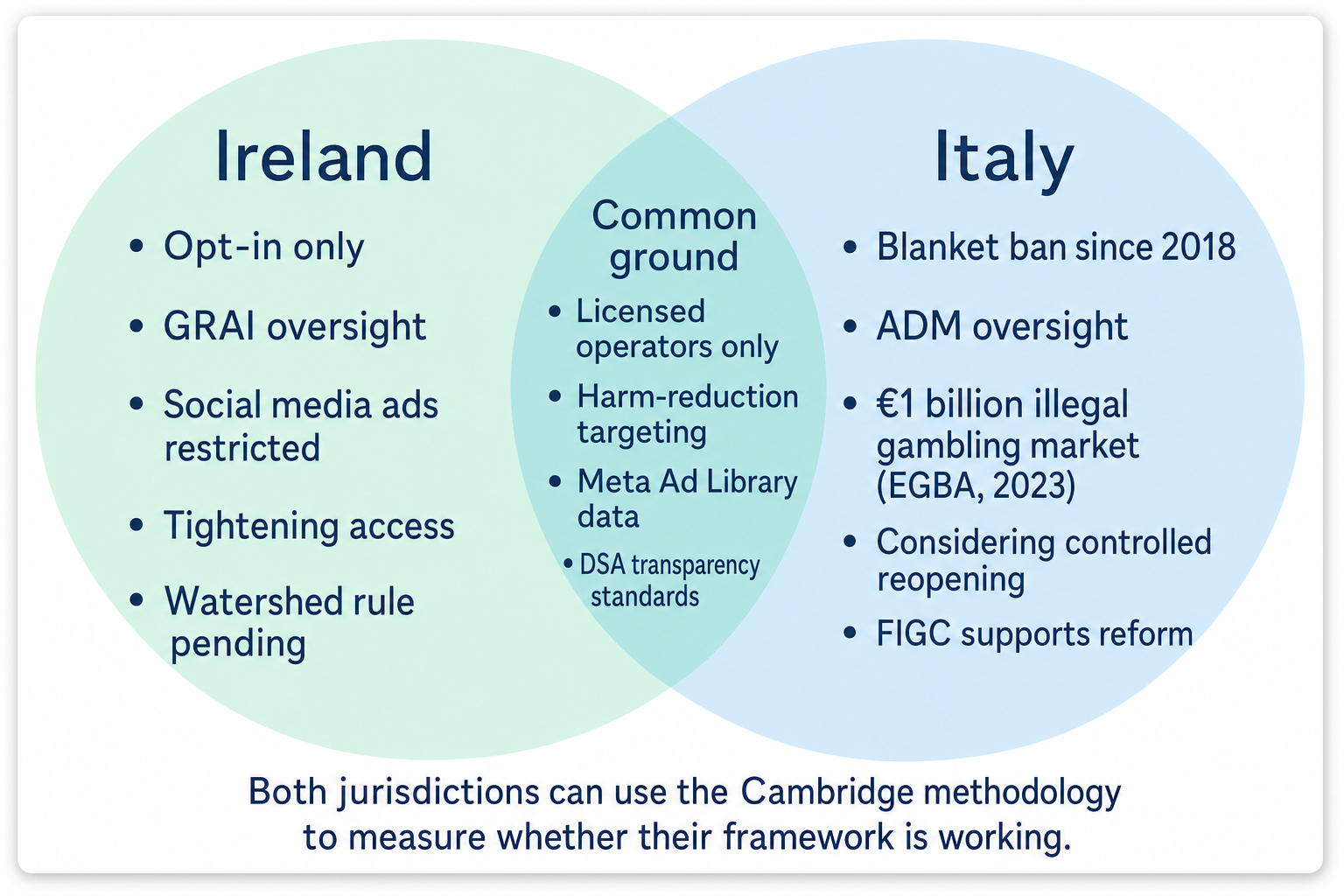
The fact that Gabriele Gravina backs the removal of the gambling advertising ban means that the discussion has moved to a policy level where economic, legal, and practical considerations intersect.
The two jurisdictions are running parallel experiments, and the Cambridge study is the instrument that could tell both whether their chosen framework is actually working. The data infrastructure to answer that question already exists — the only variable is whether regulators choose to use it.