
Article | 12 minutes read
Legal online sports betting may be pushing young American men who already drink heavily to binge drink even more. That is the central finding of a study published in March 2026. It offers early causal evidence linking the rapid expansion of US sports wagering to increased alcohol misuse.
The research found that men aged 35 and under who already binge drink experienced a roughly 10% increase in the frequency of binge drinking after online sports betting was legalized in their state.
With 31 states and Washington, D.C. now offering legal online sports wagering, the findings carry major implications for the gambling industry and public health policy alike.
The study, titled Gambling and Substance Use: Early Evidence from Sports Betting Laws, was published in Health Economics in March 2026. It used CDC Behavioral Risk Factor Surveillance System (BRFSS) data from 2016 to 2023.
The authors, Kabir Dasgupta and Keshar Ghimire, set out to test a question that has been discussed for years but has rarely been measured causally. Does easier access to sports betting change the way people drink or smoke, or do these risks simply overlap in the same users?
To answer that question, the researchers compared states that had legalized sports betting with those that had not. They used a difference-in-differences model and focused on changes after state laws were enacted, especially in areas where online betting became available.
Key findings include:
For context, in this study, binge drinking means consuming five or more drinks in a single sitting for men.
The study’s main finding was narrow in scope but still important. The rise did not show up as a broad increase in drinking across all adults. It showed up in the frequency of binge drinking among younger men who were already in a higher-risk drinking group.
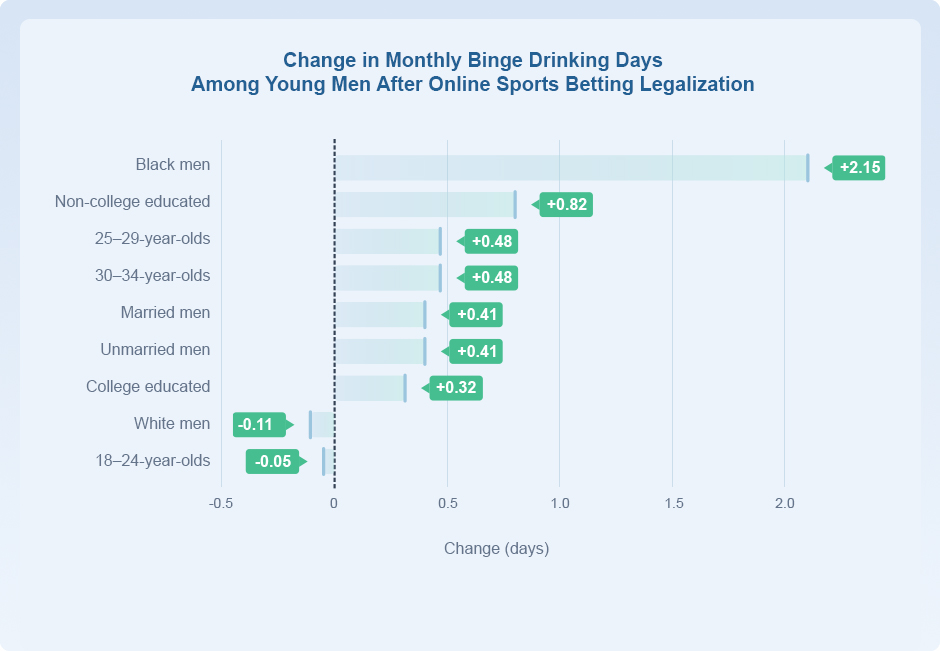
Not all young men face equal exposure. The study also looked at differences within the younger male group. The subgroup analysis revealed clear disparities in risk distribution after online sports betting was legalized.
That does not mean those groups are the only people at risk. However, it does suggest that harm is not spread evenly. The public health effect may lie at the intersection of age, access, existing drinking habits, and the social settings where sports betting happens.
One of the study’s most striking distinctions is between online and retail sports betting. Both forms of access showed some initial effects on binge drinking. However, the impact of online access proved far more persistent.
According to the event study analysis, the effects of retail-only laws appeared to fade after a few years. In contrast, the effects of online betting laws showed no sign of weakening, even five years after implementation.
Online betting is always on and easily accessible by smartphone. It can become part of everyday sports viewing, especially in bars, where heavy drinking is already common.
“Online sports betting differs from traditional gambling because it is immediate, continuous, and easily accessible through smartphones… That accessibility may make it easier for gambling to occur in settings where alcohol consumption is already common, such as watching live sports.”
Keshar Ghimire, study co-author
This research provides early causal evidence, making it more valuable than a simple survey snapshot. It uses real policy changes across states and a large health dataset to examine changes after legalization.
Still, the authors are clear about the limitations. The BRFSS relies on self-reported behavior, which means actual alcohol use may be higher than reported. The paper also covers the first years of sports betting expansion, so the longer-term effect remains uncertain.
The researchers also tested whether COVID-era drinking patterns might explain the result. They found similar patterns in a pre-COVID sample, which strengthens the case that online sports betting access is part of the story.
The study points to a causal link, but it does not show exactly why the increase occurs. Increased binge drinking could stem from direct triggers, such as drinking while placing live bets.
It could also come from indirect pathways, such as the financial stress and mental health strain that gambling can cause, which is why access to gambling support and advice matters.
The study adds to a growing concern that the harms linked to sports betting extend beyond gambling losses alone. It provides evidence that legalized online wagering increases binge drinking among the very group most likely to participate: young men who already drink heavily.
The findings do not amount to an argument against legalized betting. Rather, they make a case for more precise harm prevention. If the clearest risk lies with younger men who already binge drink, then the most useful response may be targeted messaging and better coordination between gambling and alcohol harm strategies.
Responsible gambling frameworks must now account for these spillover effects. As more states weigh legalization and gambling participation hits new heights, the conversation must stretch beyond problem gambling to include the other real-world health risks that follow.