
Article | 12 minutes read

When the UK Gambling Commission capped bonus wagering at 10x in January 2026, it framed the change as a way to reduce gambling-related harm and improve transparency. Four months later, our analysis of 150 UKGC-licensed welcome offers shows the cap did exactly what it was designed to do. Every offer in the dataset now sits at 10x or below. Not one exceeds it.
And yet 134 of those 150 offers, just under 90%, still carry at least one design feature that pushes players toward longer, faster, or more anxious play. The Commission capped how much a player has to wager. It said almost nothing about the mechanics that shape how they wager, and almost nothing about whether a bonus carries wagering at all. For the players these offers are aimed at, that gap is where the real risk now lives.
That second omission turns out to be the more important one. When you sort the data, the multiplier is not what separates a clean offer from a harmful one. The dividing line runs somewhere that the reform never drew.
The dataset covers 150 welcome bonuses from UKGC-licensed online casinos, with terms analyzed between early May and early June 2026. Each offer was scored from 1 to 10 from a player’s perspective and checked against eight defined harm mechanics. These are not vague impressions. Each is a specific, identifiable clause in the terms and conditions.
Each one maps to a specific way an offer can push a player toward spending more time or money than they planned.
The first four mainly concern time pressure, withdrawal restrictions, access to funds, and inactivity. The remaining four are about forced losses, manufactured daily habits, and loss-only activation. None of them are addressed by the 10x bonus wagering cap. None of them were the focus of the January reforms.
Two numbers tell the story together.
The first is 100%. Every offer analyzed complies with the new wagering cap. On that measure, the market adjusted cleanly and quickly. Whatever debate surrounded the reforms before they landed, operators have implemented the headline rule.
The second is 89%. That is the share of offers still carrying at least one harm mechanic. Only 16 of the 150 are clean on all eight counts.
The mechanic-level breakdown shows where the weight sits:
| Harm mechanic | Offers affected | Share |
|---|---|---|
| Withdrawal forfeiture | 98 | 65% |
| Short expiry (72h or less) | 78 | 52% |
| Reverse-order return mechanic | 56 | 37% |
| Rolling login penalty | 21 | 14% |
| Forced cash exhaustion | 15 | 10% |
| Same-day urgency | 7 | 5% |
| Loss-triggered bonus | 7 | 5% |
| Daily drip | 3 | 2% |
Withdrawal forfeiture is the most common single feature in the entire UK welcome bonus market. Almost two thirds of offers void the bonus and its winnings if a player tries to withdraw before clearing the wagering. This sits awkwardly against the goal of improving transparency, because the clause works precisely by making the cost of leaving invisible until the player tries to leave.
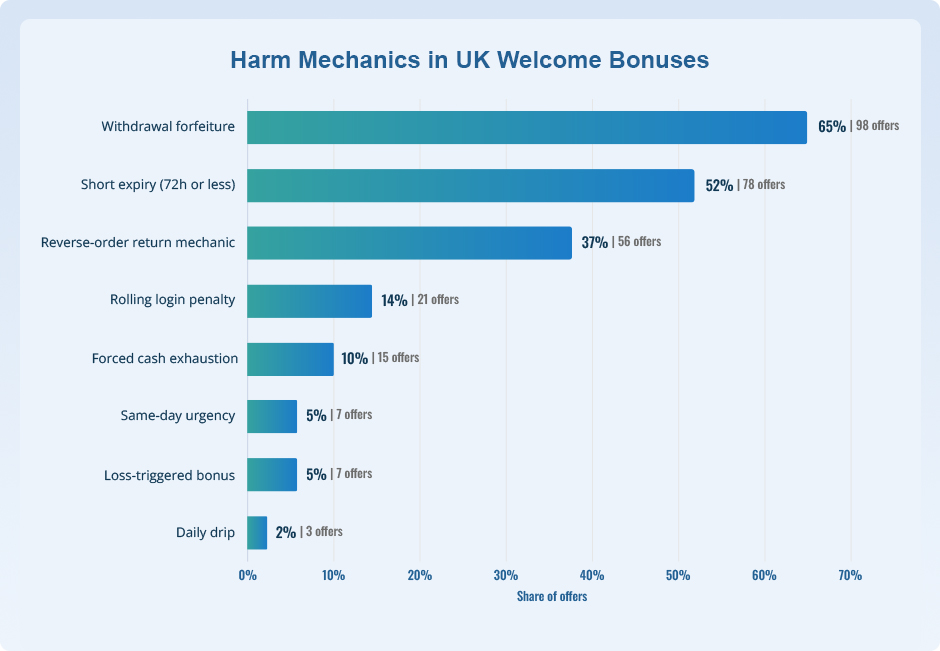
Short expiry is close behind at just over half the market. This is the first clue that the wagering cap alone does not settle the question of harm. A 10x requirement with a 24-hour clock can drive faster, more intense play than a 30x requirement spread over a month. The cap lowered the total amount that must be wagered. It did nothing about the speed at which the offer demands it be done.
It helps to see the clause in the real world, because the wording shows how it works, and how it differs from the wagering requirement people often confuse it with. The wagering requirement is what locks the winnings until a player has bet enough.
The forfeiture clause is a separate line governing what happens if the player tries to stop before reaching that point. Across the dataset, it is written in a strikingly consistent way:
Common forfeiture clause across UKGC-licensed welcome offers
Alternative phrasing observed in the dataset
The trigger is the act of withdrawing. The consequence is the loss of the bonus and everything won with it. The verb choice matters. “Removed” and “canceled” appear more often than “forfeited,” which softens a clause that does exactly what the harsher word implies.
The practical effect is to remove a player’s exit. Someone who is ahead and would like to stop cannot bank a partial win. Their only routes are to gamble through the full wagering requirement or to walk away with nothing from the bonus.
Because every required bet carries the house edge, grinding through the requirement tends to erode the very winnings the player was trying to protect. The clause does not directly confiscate the money. It keeps the player in the game, and continued play does the rest.
For a player, the practical defense is to spot this clause before opting in. If the terms void your winnings on an early withdrawal, you are agreeing up front that you cannot bank a win and simply walk away.
That this is a design choice rather than a structural necessity is clear from the offers that decline to write it. The same dataset, the same regulator, contains licensed UK offers whose terms read the other way:
Wager-free offer terms on the UK market
Alternative terms found in the same dataset
Here is the finding that reframes the rest. The reform set a ceiling on the wagering multiplier. But the multiplier does not predict whether an offer is clean. The presence of wagering at all does. When the 150 offers are sorted into those with a wagering requirement and those without, the split is stark.
Every offer scoring 7 or above is wager-free, all 20 of them. Not a single high-scoring offer in the dataset carries a wagering requirement of any size. And of the 16 offers that are completely clean across all eight harm mechanics, 15 are wager-free.
Exactly one carries a wagering requirement and stays clean on everything else. It does so by setting wagering at 2x, a fifth of what the cap permits, while still scoring only in the middle of the table.
In other words, a wagered offer that avoids every harm mechanic is, in this market, a sample of one. Once an offer attaches any wagering, it picks up at least one harm mechanic alongside it. The cap allows up to 10x. The data shows that almost nothing good happens at 10x.
The score-against-mechanics gradient says the same thing from another angle:
| Player score | Number of offers | Average harm mechanics each |
|---|---|---|
| 8 / 10 | 3 | 0.33 |
| 7 / 10 | 17 | 0.65 |
| 6 / 10 | 39 | 1.95 |
| 5 / 10 | 54 | 2.20 |
| 4 / 10 | 33 | 2.12 |
| 3 / 10 | 4 | 2.00 |
The offers that score well carry almost no mechanics. The rest of the market clusters around two each. The drop is not gradual; it is a cliff between the wager-free top and the wagered middle.
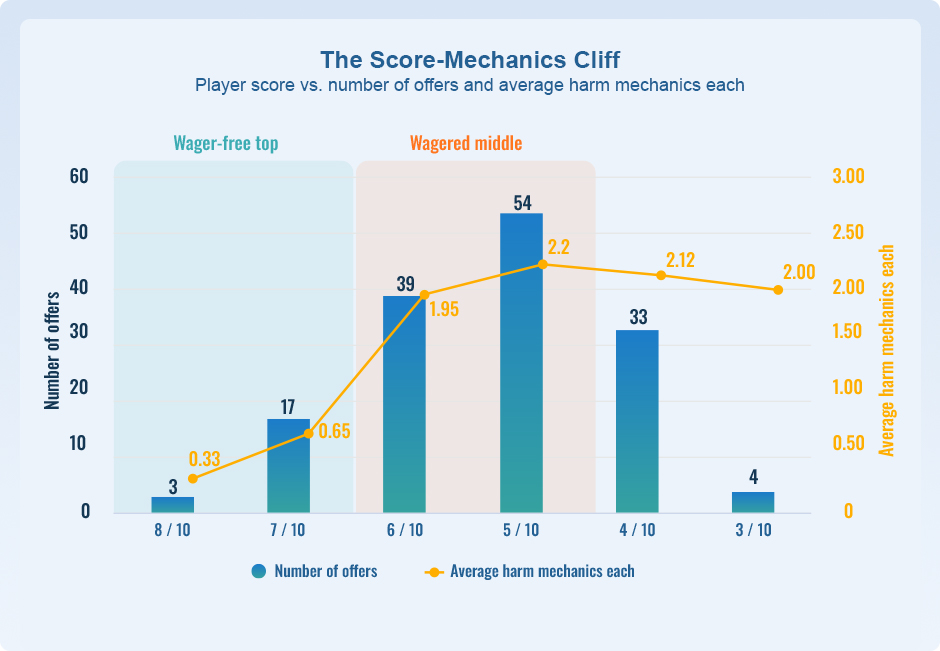
So the real dividing line in the post-reform market is not 10x versus 30x. It is wagered versus wager-free. The reform regulated the number the data says barely matters, and left untouched the distinction that does.
If you go looking for the exception, the offers that wager at the full 10x but spare players the forfeiture clause, you can find them. Twelve offers in the dataset combine 10x wagering with no withdrawal forfeiture.
But not one of those twelve is otherwise clean. Every single one carries at least one other harm mechanic in forfeiture’s place, almost always a short expiry clock or a reverse-order return mechanic. Drop the forfeiture, and a tight deadline or a play-the-bonus-first rule appears to do the same job.
This is the behavior of communicating vessels. The mechanics are partly interchangeable, because they serve the same underlying purpose, which is to keep a player in the game rather than let them bank a win and leave. Removing one does not make an offer safe. It tends to shift the pressure elsewhere in the terms.
That is why capping a single dimension of a bonus, however sensible in isolation, struggles to reduce harm overall. The harm is not located in any one clause. It is distributed across a toolkit, and operators can shift between tools.
There is a structural reason these features are so widespread, and it has implications for how any future regulation would work.
Harm mechanics do not appear at random across individual brands. They cluster at the level of the operator group and its shared platform terms. In several of the larger groups in the dataset, a single set of bonus policy documents propagates the same mechanic across all the brands the group runs.
One group of 13 brands carries both withdrawal forfeiture and the rolling login penalty across the entire portfolio. A four-brand group carries forfeiture and forced cash exhaustion across all of its brands. The handful of daily-drip offers in the whole dataset all belong to one group.
This matters in two directions. It explains why a single mechanic can show up in dozens of offers at once: it is written once and inherited everywhere. But it also points to an efficient lever. A regulator that addressed a mechanic at the level of group platform terms would change behavior across an entire brand portfolio with one intervention, rather than chasing individual offers one at a time.
A fair point on the mechanics here: not all of them are equally indefensible. Expiry windows have a legitimate commercial logic, because no operator can leave an offer open indefinitely. Some restrictions exist to deter bonus abuse rather than to trap ordinary players.
The point is not that every clause is predatory. It is that the current rules draw the line at wagering size and leave everything else to the operator’s discretion, and the data shows where that discretion tends to land.
The January reforms were never presented as the end of the conversation. The Commission said it would monitor the impact of the new bonus rules and assess whether further adjustments are needed based on evidence of how players actually experience them. This dataset is one early piece of that evidence, and it points in a fairly clear direction.
Three takeaways stand out:
These takeaways arrive at a moment when the UK is already investing more heavily in consumer-protection infrastructure. The mechanics layer is the next obvious target.
The 10x cap was a real improvement on the worst offers, and the market complied with it in full. But compliance and protection are not the same thing. Almost nine in ten UK welcome offers still carry a feature designed to keep players in play, and the most common one punishes them for cashing out.
The clearest signal in the data is also the most uncomfortable for the reform. The cap worked on paper, but changed less than it appears to have. Every clean offer in the market is, with a single exception, an offer with no wagering at all. The harm did not survive despite the rules. It survived in the space where the rules did not reach.
If the next round of reform wants to close that space, the data is fairly direct about where to look. Not at the multiplier, which the market has already absorbed, but at the mechanics the multiplier was never going to touch.
For players, the takeaway is not to avoid welcome offers but to read them with these mechanics in mind. The 10x cap does not make a bonus safe, and a low wagering figure tells you little on its own. Before you opt in, look past the headline number to the terms underneath.
It also helps to recognize the harm mechanics that are attached to bonuses. If a deadline or a playthrough rule is pushing you to bet faster, longer, or more than you meant to, that is the clause doing its job. The safer response is to set deposit and time limits before you start, not after.